My manifesto: intelligent modernization
I write these insights to turn modernization into learning you can apply next week.
My manifesto
I’m Freddy Vorstenbosch — founder, advisor, and board chair working on strategic systems and business modernization. I’m based in Rio de Janeiro, Brazil, and I work in English, Dutch, and Portuguese.
For over a decade, I’ve specialized in translating business drivers into operational, financial, and informational excellence. The pattern I keep seeing is simple: organizations ship “modernization” projects, but don’t modernize the way decisions get made or how learning moves through the system.
This site exists to make modernization learnable.
In one minute
- I write to make modernization a capability you can practice, not a project you “complete”.
- I focus on observable signals: decisions, lead time, incidents, and recurring meeting dynamics.
- Each insight ends with small moves you can try next week.
My working principles
- Work over theory. I care about what changes behavior in real decision forums, not what sounds good in a framework.
- Dialogue over broadcast. This is not “read and accept” or “read and disagree”. It’s a conversation — bring counter‑examples, signals, and better questions.
- Signals over slogans. If a claim matters, we should be able to observe it in artifacts: decisions, escalations, lead time, incident patterns, and recurring meeting dynamics.
- Big picture, small steps. Hold a shared view of the system (outcomes, constraints, trade‑offs), then move through 1–2 week micro‑pilots with a clear “watch” signal so the big idea becomes learnable.
- Progress, not perfection. Publish a useful first version, learn in public, iterate.
- Clarity over complexity. Plain language, explicit terms, minimal frameworks.
What I mean by intelligent modernization
Definition
Modernization is not “new tech”. It’s the capability to change the system without breaking its identity.
When that capability is real, teams decide in public, learn fast, and keep decisions close to the work. When it’s missing, work escalates, forums fill up, and leaders become bottlenecks.
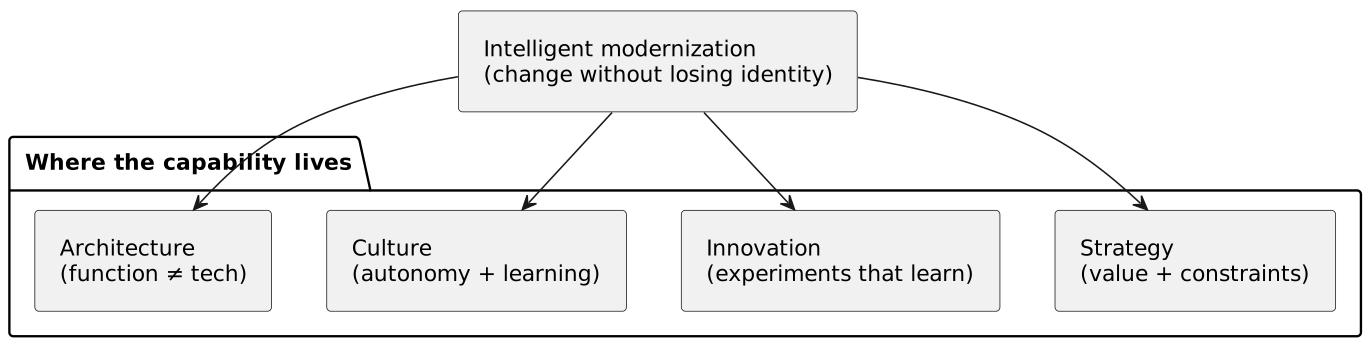
In my experience, that capability lives in four places: strategy, architecture, innovation, and culture — not as slogans, but as measurable behaviors.
Here’s a simple map of how I think about it:
How to use these insights
Each insight is designed for two speeds: a 60‑second skim and a deeper read. I keep a fixed structure so you can find what you need quickly:
- Insight — the thesis and the tension
- Context — where it shows up in real organizations
- Evidence — why it happens (a simple mental model)
- Signals — how to spot it in your own system
- Action — small experiments you can run next week
I don’t publish opinions dressed as certainty. I don’t invent statistics. If a claim matters, it should show up in signals you can observe.
Every insight ends with a question on purpose: the point is not agreement — it’s better collective learning.
If you want to continue the conversation, you’ll find a bit more about me below.
Why I founded LEF (our mission)
I founded LEF to do this work with others — turning strategic intent into systems that actually change outcomes. When I say “we” below, I’m referring to LEF.
Our mission is to turn complexity into clarity and routine into learning — by improving decision quality, shortening feedback loops, and designing digital foundations that keep autonomy inside explicit guardrails.
Essence
Intelligent technology turns static systems into living architectures — open, adaptable, and sustainable. It helps create more lucid organizations, ready to learn and change with autonomy.
Important
Modernizing is aligning humans, processes, and code in a continuous rhythm of evolution, with clear purpose and the courage to do things differently.
Perspectives
- Intelligent Strategy — Orchestrate strategy →
- Living Architecture — Shape architecture →
- Real Innovation — Unlock innovation →
- Culture in Transformation — Cultivate a living culture →
Principles for intelligent technology
These principles translate this essence into concrete choices in technology, architecture, and culture.
-
Separate function from technology.
Ideas change faster than code. When business logic is independent from technical structure, the organization can reinvent itself without fear of breaking the system.
Living Architecture -
Design for adaptation.
Anything that is alive needs to change. Creating modular, interoperable systems ensures that evolution can happen without rebuilding everything.
Intelligent Strategy -
Automate with intention.
Automating means freeing human time, not replacing thinking. Technology should amplify creativity, not automatism.
Real Innovation -
Measure to learn.
Metrics are not an end in themselves, but a mirror of what we are learning. Evaluating impact, clarity, and evolution reveals whether the system is truly alive.
Intelligent Strategy -
Treat the system as a living organism.
An intelligent system listens, adjusts, and evolves with the people who use it. It learns with reality, not against it.
Living Architecture -
Prioritize clarity over complexity.
Complexity is not a sign of sophistication. Clear systems strengthen decisions, reduce noise, and expand autonomy.
Intelligent Strategy -
Invest in culture before code.
Every technology reflects the behavior of those who build it. No system thrives where the culture resists learning.
Culture in Transformation
At LEF, we believe modernization is not a technical end in itself, but a way of building better conditions for people and organizations to learn.
Through this site, I share insights, practices, and ideas for cultivating technology that strengthens decision-making, autonomy, and long-term adaptability.