
Why stable systems need moving parts
Stable systems do not remove complexity. They decide where variety stays open, where it becomes standard, and where true exceptions go before anything becomes truth the organization relies on.
A system is one whole, but its parts should not all move the same way. Good systems decide where to stay open to real-world variety, where to standardize for scale, and where to route true exceptions without letting them redefine the core.
Stable systems classify reality before they commit it
Insight: Stable systems stay stable because they do not remove complexity. They decide where variety stays open, where it becomes standard, and where true exceptions go before anything becomes truth the organization relies on.
A team wants to change a customer journey next week because people are dropping out halfway through. Operations needs a different approval rule this month because the current one is creating delays. Finance still expects the underlying transaction record to stay consistent every day, every close, every audit.
That is not just a software problem. The same pattern shows up in manual procedures, service operations, compliance flows, approval forums, and digital products. Here, system means the whole operating model: the software, processes, rules, teams, and subsystems that together deliver the outcome. One system is trying to stay usable at the edge, coordinated in the middle, and dependable at the core.
The mistake is not failing to think holistically. The mistake is thinking the whole can be designed as if every part should move the same way. It cannot. Reality arrives with more variety than any organization can process directly. Before people can act systematically, they need categories, rules, procedures, and interpretations that make that variety workable. Only after that should something become truth the organization is ready to rely on.
This happens because stability does not come from making everything rigid. It comes from placing complexity deliberately. Some parts of the system should stay open to variety because that is where the system senses the real world. Some parts should standardize that variety because that is how coordinated action becomes possible. Some parts should hold only what the organization is ready to record and stand behind later. Good systems also know that not everything fits the standard path. When the design offers no proper place for unusual cases, people force them into the wrong category, or abandon them outside the system entirely.
In one minute
- Stable systems do not remove complexity; they place it.
- The key design question is where variety stays open, where it becomes standard, and where true exceptions go.
- Start by finding the variety decoupling point in one workflow before you redesign anything.
Why modernization debates keep missing the real problem
This is why so many modernization debates feel repetitive. One group argues for tighter control because the system has become too risky to trust. Another argues for looser boundaries because the system has become too hard to change. Both are reacting to the same underlying mistake: the system has lost clarity about where variety should stay open and where it should be compressed into standards.
That is also why architecture arguments so often attach themselves to technology labels. Monolith versus microservices is only one example. The deeper issue is not shape first. It is placement. Where is the variety decoupling point? How long should the system stay open to real-world difference, and when should it start enforcing standard treatment? Without that clarity, every tension turns into an argument about platform shape or team structure.
In practice, most organizations do not suffer from “wrong architecture” in the abstract. They suffer because the decoupling point sits in the wrong place. Sometimes the system standardizes too early and becomes blind to real variety. Sometimes it standardizes too late and pushes too much ambiguity into records, operations, or the core. Either way, complexity does not disappear. It just lands in the wrong part of the system.
Variety, standards, and relied-on truth
By variety, I mean the messy reality that appears first: user behavior, market response, workflow friction, drop-off points, support patterns, local exceptions, and the many differences a system has to notice before it can respond. By standard treatment, I mean the workable interpretation of that variety: rules, categories, policies, procedures, routing, approvals, and operating choices that make reality simple enough to act on at scale. By relied-on truth, I mean what the organization is finally ready to record and rely on later: orders, balances, bookings, entitlements, ledgers, histories, contractual commitments, and other durable facts.
No organization can process unlimited variety case by case forever. To act at scale, it has to simplify reality enough to decide. That is not a defect. It is how systematic action becomes possible. The real design question is where that simplification should happen. Every system has a variety decoupling point: a place where open-ended variety starts being translated into standard treatment. Before that point, custom handling may be correct because the system still needs to sense and respond to real difference. After that point, more standardization is usually correct because the system needs coordination, efficiency, and trust. Better systems are clear about that boundary and give true exceptions an explicit route instead of forcing them into the wrong bucket or dropping them entirely.
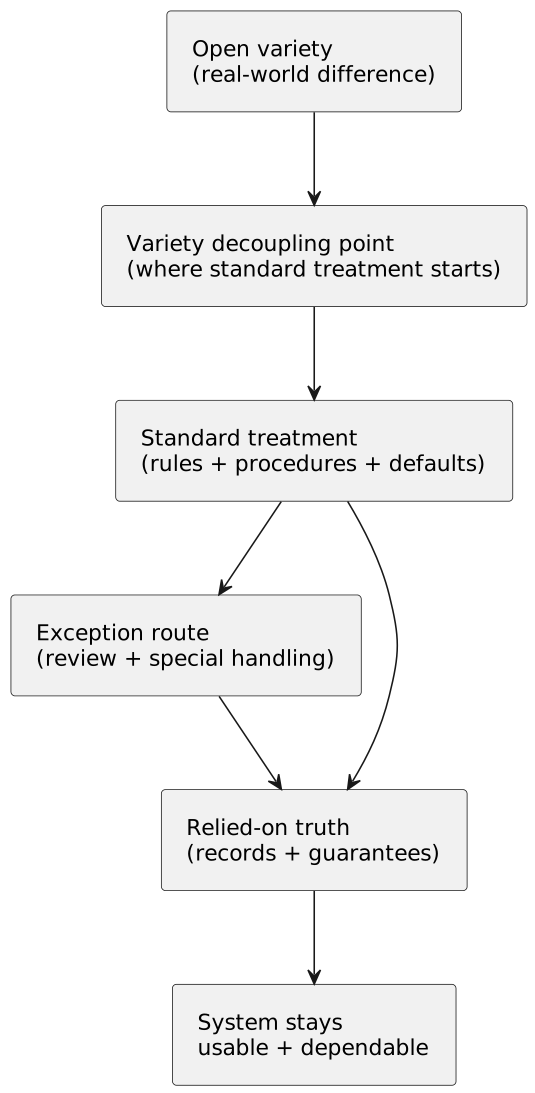
Variety appears first. The edge sees more difference than the rest of the organization can safely compress. That is why this part of the system should be easy to inspect, easy to adapt, and close to real behavior. In some systems, especially communication-heavy or support-heavy ones, custom handling near the edge is not residual at all. It is part of the job.
The decoupling point decides where standard treatment starts. This is the design choice that says, “from here on, these differences will be handled through common rules, common procedures, common records, and common controls.” Put that point too early and the system flattens real-world difference too soon. Put it too late and the system carries too much custom handling into operations and the core. That is one reason systems cannot hold ambiguity: they have nowhere explicit to turn tension into workable treatment.
Relied-on truth should come last. This layer should resist casual change because it defines what the organization will later rely on: what happened, what was agreed, what is owed, what is valid, and what must reconcile. Exceptions may also be recorded here, but as explicit exceptions, overrides, or reviewed cases, not as accidental redefinitions of the core. The point is not to avoid recording variety. The point is to avoid letting unresolved variety define the system by accident.
This distinction matters less in a tiny system changed end to end by one team. It matters much more once the same core supports many teams, channels, products, procedures, and controls at the same time.
How to spot misplaced complexity in the wild
Look in product reviews, release plans, exception logs, incident notes, audit pain, and recurring architecture arguments. The question is not whether the system changes. The question is whether each change is landing in the right part of the system.
Small customer-facing changes feel too expensive. A copy update, a flow tweak, or a new channel experiment triggers core coordination, long testing cycles, approval pain, or high release risk. That usually means the decoupling point sits too early, too close to the user-facing edge.
Business changes require archaeology across tools and procedures. A pricing tweak, an approval threshold, or a routing rule change sends people searching across UI logic, services, jobs, SQL, documents, and meeting habits to find what the current rule even is. That is a sign the system lacks a clear place where variety becomes standard treatment.
Real exceptions get squeezed into the nearest category. People choose the “least wrong” option in a form, invent a workaround in a spreadsheet, or push a special case through a standard flow because there is no explicit route for it. That usually means the design is standardizing too aggressively or not offering a deliberate exception path.
Correction work keeps growing behind the scenes. Teams keep launching changes, yet duplicate records, manual adjustments, reconciliation effort, exception handling, and side procedures all rise at the same time. That is what it looks like when the decoupling point sits too late and too much variety reaches the parts that are supposed to stay dependable.
Functional design problems keep getting framed as technology problems. The room argues about monoliths, services, platforms, tools, or ownership, but cannot clearly say where the workflow stays open to variety, where standard treatment begins, and where truth becomes relied on. That usually means the discussion is happening one layer too high.
Place complexity before you redesign the shape
Suggested moves — pick one to try for 1–2 weeks, then review what you learned.
Find the variety decoupling point in one workflow
Take one important workflow such as onboarding, pricing, claims, or returns and map it in three passes. First mark where the system needs to stay open to real-world variety. Then mark where standard treatment should begin. Then mark what the organization is finally ready to record and rely on. In the same workshop, mark which cases are common enough to standardize and which ones need an explicit exception route. Start with one workflow and watch whether requests become easier to place instead of sounding like one undifferentiated need for “change.”
Make standard treatment and exception routes explicit
Choose one recurring business change, such as eligibility, approval, or routing, and make its treatment explicit in one place. That may be a rule set, a procedure, a governance rule, or a clearer handoff. Include two things: what the default treatment is and where true exceptions go next. This works because systems scale through standards, but stay inclusive through deliberate exception paths. Start with one decision type and one named owner, then watch whether the next change becomes an update to treatment instead of a rediscovery exercise across code, documents, and meetings.
Review the design through three lenses
Look at one workflow through three lenses. As a CEO, ask where the business needs openness to real variety and where it needs dependable standards. As an architect, ask where the decoupling point sits and whether it is too early or too late. As an operator, ask where people are still choosing the least wrong option because the system gives them no proper path. Start with one workflow and watch whether the discussion becomes less abstract and more actionable.
Good architecture is not a style choice first. It is a placement decision. It decides where the system stays open to variety, where it begins to standardize, where exceptions are routed, and where truth becomes something the organization relies on.
That is why stable systems need moving parts. Not everything should be custom. Not everything should be standard. Variety should stay visible where the system still needs to learn from it. Standards should take over where the system needs coordinated action. True exceptions should stay inside the system. And only then should something become truth the organization relies on.
The next useful question is concrete: in one important workflow, where is the system asking people to hide real variety just to keep work moving?
Where in one important workflow are people still choosing the least wrong option just to keep work moving?