The comfort of the known and the cost of curiosity
Algorithmic logic brings us closer to what we already know and pushes away what we could discover. Real evolution happens outside the predictable.
From social networks to search engines, we live inside systems that amplify what is familiar and downplay what is new. It is easy to follow trends and hard to stay curious. Transformation starts when we step out of the confirmation loop and return to exploring on our own.
Algorithms optimize comfort, not discovery
Insight: Algorithms optimize comfort, not discovery — so curiosity must become deliberate.
Algorithms bring us closer to what we already know; evolution happens outside the predictable.
From search to recommendations, most systems optimize for clicks, watch time, and similarity to past behavior. The result is more of the same: popularity becomes a proxy for relevance, and the new falls off the radar. Without deliberate mechanisms for discovery, exploration shrinks and thinking converges. Gradually, we trade curiosity for comfort and confuse familiarity with quality.
This happens because engagement-driven systems are built to keep attention, and attention is easier to keep inside familiarity than inside novelty.
In one minute
- In algorithmic environments, curiosity stops being a reflex and becomes a deliberate practice.
- The system rewards confirmation (what’s similar) more than discovery (what’s unfamiliar), so your information field narrows unless you actively widen it.
- Start by designing one “outside the feed” habit you can sustain for 30 days.
When “what’s popular” becomes “what’s true”
This isn’t only about social media. The same pattern shows up in organizations: decisions justified by “everyone is doing it”, roadmaps shaped by the loudest trend, and leadership conversations that recycle the same few narratives.
When discovery shrinks, strategy shrinks with it. Teams become less able to see weak signals early, less willing to challenge consensus, and slower to adapt when reality stops behaving like yesterday.
The confirmation loop is a system (not a moral failing)
Digital systems are designed to keep attention, not to stretch thinking. Engagement metrics reward confirmation more than cognitive friction or genuine novelty: it is safer, from the algorithm’s perspective, to offer something similar to what worked yesterday than to take the risk of showing something unfamiliar today.
Here’s a simple mental model: the confirmation loop. Recommendations learn from similarity, then shape your inputs, which shapes your next behavior, which reinforces what the system thinks you want. Without intentional interruption, the loop narrows your informational field over time.
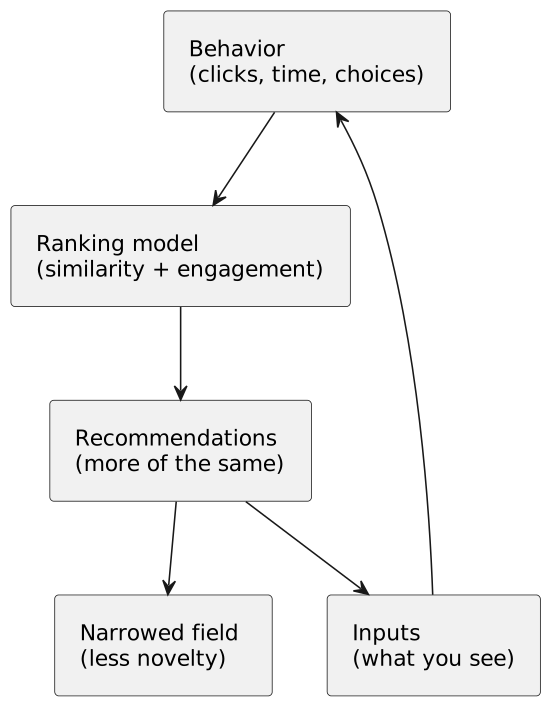
Human curators have also been gradually replaced by automatic feeds that privilege predictability and scale. The result is a subtle, persistent pressure toward the comfort of the known.
This is less damaging when decisions are reversible and feedback is fast. It becomes dangerous when choices are high-stakes, slow to reverse, and made under uncertainty with narrow inputs.
How to tell your discovery muscle is weakening
If you pay attention to your own information habits — and your team’s decision habits — a few signals tend to appear.
Feed. Your feed feels “perfect”, but it’s also narrow — low serendipity, high familiarity, and a shrinking range of ideas. That’s confirmation being rewarded more than discovery. A good first move is to intentionally add sources that disagree with you and topics you do not usually follow.
Repetition. The same recommendations keep reappearing, and even “new” content feels like variations on yesterday’s theme. That’s insufficient exploration in the algorithm — and in your habits. A practical way to start is to manually search for authors and themes outside your usual circle.
Herd. In organizations, you hear “everyone is doing it” as a justification, and trend language replaces reasoning. That’s informational conformism masquerading as consensus. One simple move is to test alternatives before copying the trend; explicitly ask “what if we did the opposite?”
Design discovery on purpose
Suggested moves — pick one to try for 1–2 weeks, then review what you learned.
Build an intentional information mix (70/20/10)
Aim for a 70/20/10 mix: 70% trusted sources, 20% different perspectives, 10% intentionally random content. This works because discovery requires exposure; without a deliberate mix, similarity wins by default.
Start by choosing one weekly slot and pre‑selecting sources for the 20% and 10% buckets. Watch whether your “inputs” feel more diverse — and whether your decisions cite more than one narrative.
Practice manual curation (reduce feed control)
Subscribe to three newsletters outside your bubble and keep a list of “authors who disagree with me”. This matters because feeds optimize for stickiness, not breadth; manual curation restores agency.
Start by picking one theme you rarely explore and adding one subscription today, then add one author per week for a month. Watch how often you encounter ideas that challenge your default assumptions — and how you respond to them.
Use adversarial reading (stress-test ideas)
For every strong idea, ask “what weakens this thesis?” before you share or decide. This works because the goal isn’t novelty for novelty’s sake; it’s better judgment under uncertainty.
Start by assigning one person the role of “disconfirming evidence” for 10 minutes in your next meeting. Watch for fewer trend‑copy decisions and more explicit trade‑offs captured in notes.
In algorithm-mediated environments, curiosity becomes a conscious choice. Escaping the comfort of the known requires deliberately designing how you will encounter what you do not yet know.
If we do not build discovery habits, decisions slowly become imitative. “Because the market does it” turns into a default justification, innovation loses depth, and informational bubbles become harder to see from the inside.
What discovery habit outside your feed can you create?