
Don’t settle for ordinary
The difference is not in technology itself, but in how we use it to create value, collaboration, and purpose.
In an interconnected world, standing out requires combining people, processes, and software intelligently — cultivating a culture of continuous evolution.
Standards connect us; co-creation differentiates us
Insight: Standards create alignment, but differentiation comes from how you implement them — together.
In an interconnected world, we survive on shared standards: ISO-like practices, contracts, APIs, and common operating agreements. They reduce friction and make integration possible.
The trap is confusing “standard” with “default”. When standard software and generic playbooks become the operating model, the organization starts to behave like the average company the template was designed for. You stay compatible — and quietly become interchangeable.
Differentiation comes from how people, processes, and software combine to express a unique implementation of those standards: the rules you choose, the exceptions you honor, the flows you design, and what the system makes easy.
This happens because copying the common path is socially safe — and once the software enforces it, the culture follows.
In one minute
- Standards keep you compatible; defaults make you interchangeable.
- This happens because generic software turns “average” assumptions into enforced workflows — and distance between business and tech turns co-creation into handoff.
- Start by picking three moments where “this only happens here” must be true (a team, a branch, a product line), then co-create the rules and flows on top of the shared standard.
In a connected world, sameness spreads fast
When everyone shares the same standards, tools, and playbooks, sameness spreads fast. That’s good for integration — and dangerous for differentiation.
What keeps you unique is not a slogan. It’s the accumulated choices in how decisions are made, how work flows, and what the software makes easy (or impossible).
Standards are the baseline; defaults reshape behavior
Standards are scaffolding. Defaults are decisions. When organizations adopt generic systems without questioning what they assume, software quietly reshapes behavior to fit a template that was designed for an “average company” somewhere else.
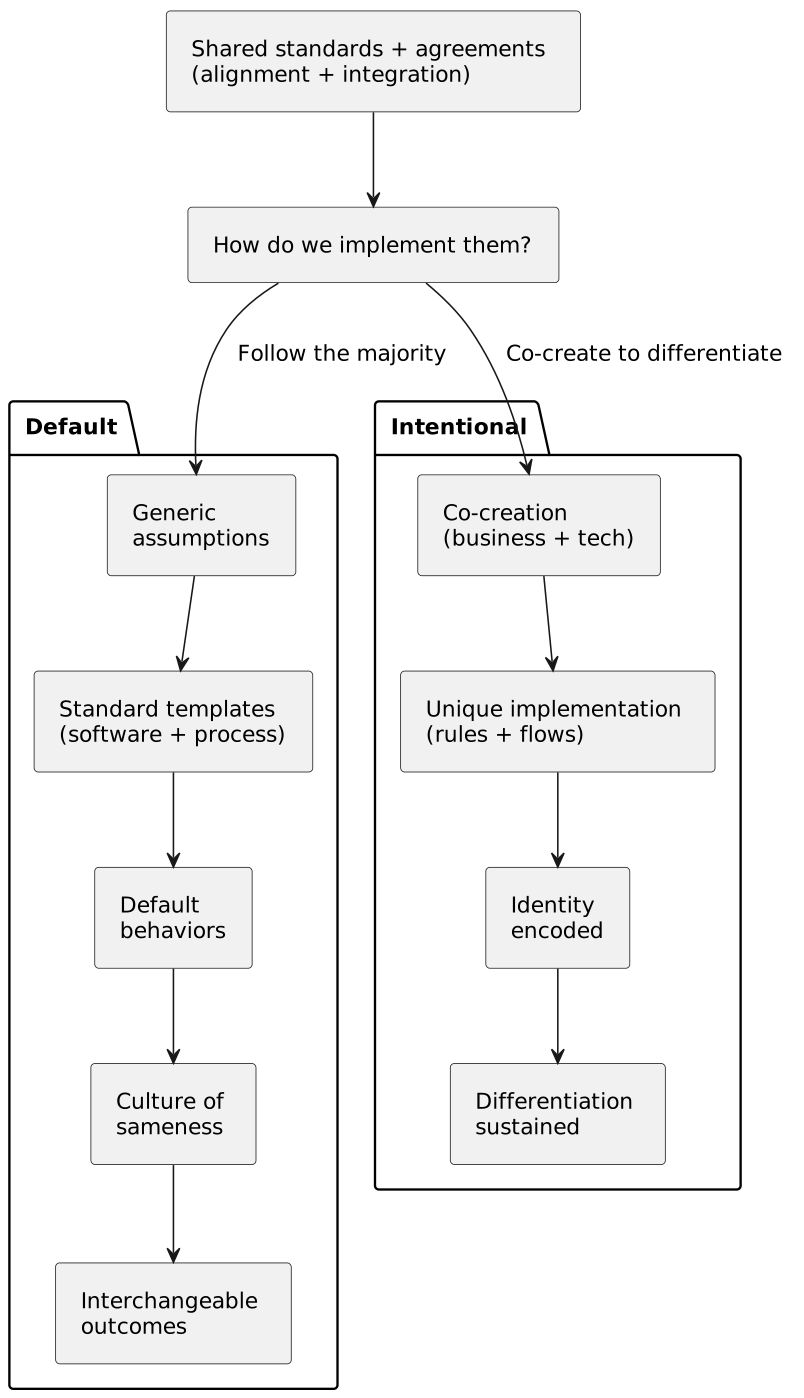
This effect is amplified when business and technology work far apart. Without co‑creation, technology teams optimize for maintainability and speed, business teams copy what seems to work in the market, and singularity is slowly edited out of processes and interfaces. In cultures where continuous learning is weak, copying the common path feels safer than experimenting with a unique one — even when the ordinary no longer creates value.
This matters less when uniformity is the goal and customers value consistency over tailoring. It matters most when a few signature moments are your differentiator and standard workflows keep erasing them.
How sameness shows up in daily work
You can often sense this loss of singularity in how processes, teams, and market moves start to look interchangeable.
Processes. Your workflows start to look like anyone else’s, and the results follow the same curve: good enough, never distinctive. Through the lens above, that’s what it looks like when generic templates quietly become “the way we work”. A good first move is to map your differentiators and embed them explicitly into systems and flows.
Team. People stop seeing value in tailoring systems because the business vision is disconnected from technology choices, so “standard” feels safer than “ours”. That distance turns co‑creation into handoff. Start by co‑creating one key flow with business areas and measuring its effect on outcomes and engagement.
Market. Your initiatives begin to read like competitors’ — the same journeys, the same steps, the same “best practice” vocabulary. That’s competitive mimicry replacing strategic positioning. One simple move is to test your own hypotheses with learning metrics, not just adoption or benchmarking.
Make “different” executable
Suggested moves — pick one to try for 1–2 weeks, then review what you learned.
Choose where “this only happens here” must be true
Identify three experiences where your singularity creates real value for customers or teams. This matters because uniqueness concentrates in a few moments; if you don’t name them, “standard workflows” erase them by default.
Start with one meeting: write the three moments and what must feel different (speed, tone, decision rights, exceptions), then turn that into visible flows and rules. Watch whether teams can point to these moments in real artifacts (screens, contracts, runbooks), not just narratives.
Co-create the flows that carry identity
Co-create flows and components that make identity visible and repeatable in the software. This works because if business and tech stay apart, the system will encode “average assumptions” and the culture will adapt to them.
Start by picking one slice of a journey and running weekly working sessions with business + tech until it matches reality. Watch for fewer workarounds and less “we can’t do this in the system” language.
Measure impact (not just delivery)
Measure adoption and impact (NPS, time‑to‑value, internal churn or frustration) for the flows you changed. This matters because differentiation is only real when it changes outcomes and behavior.
Start by defining one baseline metric and reviewing it weekly for 30 days. Watch whether customers and teams begin to say “this only happens here” when interacting with your systems.
Intelligent technology translates purpose into a distinctive way of operating: it protects what makes the organization different while simplifying what can be standard. When people, processes, and software align around this singularity, every screen, flow, and automation reinforces identity instead of erasing it.
If nothing changes, differentiation erodes and the easiest lever left is price. The organization becomes one more option among many, competing on efficiency alone while culture settles into reproducing what everyone else does.
What change in your technology culture would today reinforce what makes your organization different?