The five mistakes teams make with AI agents in process automation
Automating chaos only scales chaos; start narrow, design the process, feed context, and install feedback loops.
Most AI-agent failures come from scope, simultaneity, chaos-by-design, context starvation, and missing feedback. Treat automation as a system, not a magic wand.
AI agents scale chaos before they scale value
Insight: AI agents scale chaos before they scale value.
“Can we automate the whole process with agents?” is the new executive reflex. The demo looks magical: a bot reads an email, updates a system, writes a response, and logs the work. Then it hits production — where policies are incomplete, exceptions are undocumented, data is fragmented, and the real process was never designed end-to-end.
AI agents don’t fix broken processes — they amplify them. If small doesn’t work, big certainly won’t. The reliable path is still boring: start narrow, map the work, encode the right context, and run a tight feedback loop.
This happens because agent adoption is usually driven by pressure (to promise big) and convenience (to ship wiring) — not by the system design work that makes automation reliable.
In one minute
- Teams wire agents into messy workflows, early demos impress, and production quietly drifts in cost, quality, and trust.
- Scope inflation, unclear ownership, context starvation, and missing feedback turn automation into a brittle system that can’t learn.
- Start by picking one workflow, defining one “thin slice”, and running a two-week pilot with a test set and a weekly review.
Automation pressure rewards big promises
Leaders are under pressure to “do AI,” often phrased as: “Can we automate our entire process?” Teams spin up multiple agents at once, wired into messy workflows, with vague ownership and thin prompts. Early demos impress; production quietly degrades. Costs drift, quality drifts, and trust declines.
These failures rhyme across industries and functions. They are not model problems; they are system design problems.
Reliability comes from design, not wiring
Here’s a simple mental model: agent automation is only as reliable as the system around it. You need process clarity (what work actually is), context completeness (what the agent must know to decide), and feedback discipline (how the system learns and stays safe). When one of these is missing, automation drifts until incidents become the only visible signal.
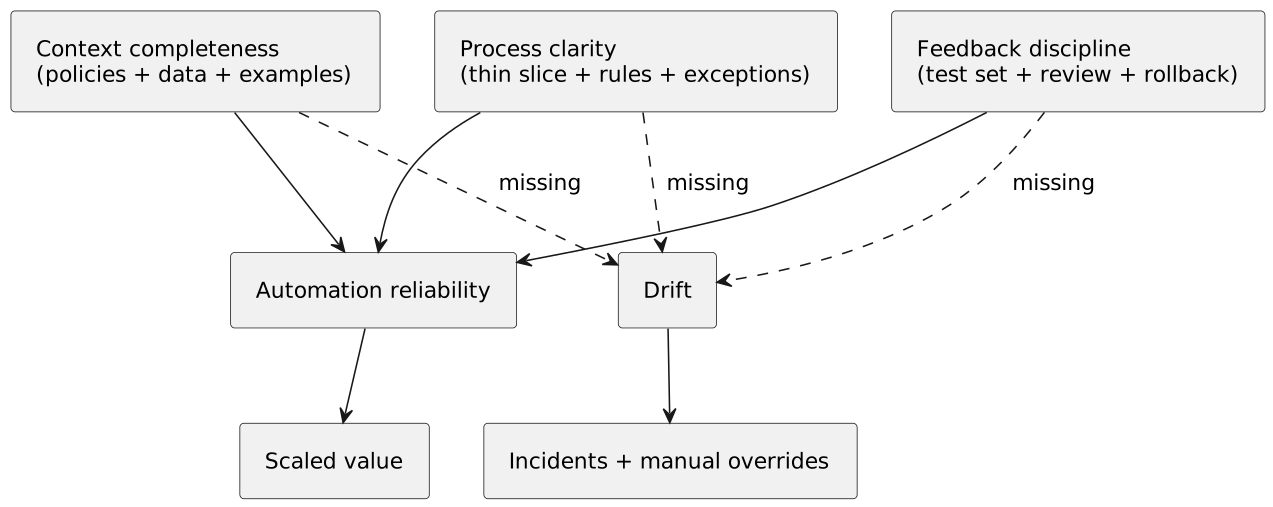
Most failures cluster around five forces:
Scope inflation. Leaders ask for “end-to-end automation” without defining a thin slice, so pilots succeed on curated scenarios while edge cases expose ambiguity and process debt that was never written down.
Too much simultaneity. Teams launch several agents with fuzzy boundaries; handoffs collide, nobody owns the outcome, and incidents fall between chairs.
Automating chaos. Without a clear service blueprint, contradictions between teams, products, and regions are encoded as-is, accelerating rework, escalations, and exceptions instead of reducing them.
Context starvation. Privacy concerns, fragmented data, and shallow prompts starve agents of policies, definitions of done, and the edge cases humans carry in their heads.
Missing feedback loops. Without a reference test set and structured human-in-the-loop review, quality and costs drift quietly in the background until they become operational pain.
This is less risky when the workflow is already stable, policies are explicit, and reversibility is high. It becomes acute when automation touches compliance-heavy, exception-rich work with unclear ownership.
Five signs you’re automating the chaos
If you want to diagnose this early, don’t look for “AI success stories”. Look at run logs, retries, manual overrides, escalation patterns, and the work people quietly route around automation.
Scope. The success rate looks great in demos, but production gets dominated by exceptions, escalations, and “we didn’t account for this” cases. You automated without a thin slice; ambiguity and process debt are showing up as edge cases. A good first move is to shrink the slice: define a clear start/finish, list the top exceptions, and decide which exceptions must stay human (for now).
Boundaries. Multiple agents touch the same workflow and it’s unclear who owns quality, cost, and failures end-to-end. You scaled simultaneity before you installed ownership and interfaces, so failures fall into the gaps. A good first move is to set a simple rule: one workflow, one agent, one owner — then make inputs/outputs explicit and write down escalation paths and error codes.
Chaos. Automation increases rework: more handoffs, more “fixing the automation”, more manual overrides. You encoded contradictions and local workarounds, so the system is now scaling inconsistency. One simple move is to build a lightweight service blueprint: align on “one way” for the slice (even if it’s imperfect), then automate that.
Context. The agent produces confident output that fails on policies, compliance rules, or domain edge cases. The agent is being asked to guess intent because it lacks policies, rubrics, and grounded examples. A useful next step is to treat context as a product: add policies, examples, and “definitions of done”, and require structured outputs you validate before action.
Feedback. Quality and cost drift slowly, and incidents are the only time anyone reviews the automation. The system can’t learn; it only reacts after the damage is visible. A safe starting move is to install a review loop with a test set, tracked metrics, and a clear rollback/disable path — then make drift visible weekly.
Redesign one workflow, then scale with discipline
Suggested moves — pick one to try for 1–2 weeks, then review what you learned.
Make the thin slice explicit (design the work)
Choose one workflow with a clear start and finish and map decisions, inputs, rules, and the top exceptions before you automate. This matters because agents amplify ambiguity; a thin slice turns “automation” into a bounded system you can learn from. Start with a 90‑minute mapping session with the people who operate the work; write the slice, the exceptions, and what stays human (for now). Watch exception rate and manual overrides as you tighten the slice.
Create ownership and interfaces (govern the system)
Assign one owner for the workflow + agent and define explicit inputs/outputs, error codes, and escalation paths. This matters because without ownership and interfaces, failures fall between teams and the system degrades quietly. Start by naming the owner, writing a one‑page interface contract, and making “who fixes what” explicit before scaling beyond one team. Watch incident resolution time and “bounced” escalations.
Install feedback and scale only after stability (make learning real)
Curate a test set (happy paths + edges), track quality/latency/cost per successful outcome, and keep humans in the loop for high‑risk decisions. This works because agents drift; feedback loops are what turn automation into a system that improves instead of a script that decays. Start by picking 3 metrics, setting a weekly review, and adding a simple “disable/rollback” switch for the slice. Watch retries, rework, and cost per successful outcome over time — do they stabilize or quietly creep?
If these forces go unchallenged, the organization will scale fragility faster than value. Rework, manual overrides, and exception handling expand in the background while dashboards celebrate “percentage of process automated”.
Over time, stakeholders lose trust and route important work around automation. Shadow processes reappear, compliance exposure grows as blind-spot decisions slip through, and run-time costs drift upward through retries and incident handling.
Perhaps most dangerously, the landscape fills with overlapping agents and scripts that nobody fully owns. When something breaks, it becomes hard to tell which automation is responsible — and tempting to conclude that “AI doesn’t work here” instead of fixing the underlying system design.
Which of these five traps shows up most often in your automation today?