
Innovation Without Constraints Goes Nowhere
Innovation does not need full certainty, but it does need clear constraints; without them, effort scatters and little really changes.
When organizations innovate from vague discomfort instead of explicit constraints, experiments multiply, portfolios look busy, and yet the core business barely moves. Clarity about boundaries, value, and risk turns innovation from theatre into leverage.
Innovation needs constraints to create leverage
Insight: Innovation needs constraints to create leverage — without them, portfolios look busy and still fail to move the core.
Innovation does not require perfect understanding of the business. People often sense that “the current state is wrong” long before they can fully explain why. The real problem is not acting with partial information — it is acting without clear constraints.
When teams innovate without knowing which outcomes, customers, and risks truly matter, energy scatters. Ideas chase local pain points instead of structural constraints. Proofs of concept look promising in isolation but do not fit together into a coherent shift in how the business creates value.
This happens because organizations avoid naming boundaries, reward activity over alignment, and run experiments in sandboxes that hide the real constraints that determine whether anything can scale.
In one minute
- Without explicit constraints, innovation portfolios look busy and still fail to move the core.
- Constraints are not bureaucracy; they are clarity about boundaries, value, and risk — the conditions for coherent learning.
- Start by naming 2–3 constraints you will deliberately move, then prune everything that doesn’t support them.
When innovation is loud but the business doesn’t move
Picture an organization that is “serious about innovation”. There is an innovation lab, a backlog of ideas, hackathons, and a steady stream of pilots. Every quarter, leaders review a long list of POCs and experiments. Some are technically impressive; many have sponsor support. Yet the same strategic complaints persist: growth is flat, customer experience feels generic, and core margins remain under pressure.
When you ask teams what problem these initiatives are really solving, the answers diverge. One group talks about customer delight, another about efficiency, another about data, another about brand relevance. Few can point to a small set of explicit constraints — for example, “time to onboard”, “cost to serve”, “risk per unit of growth” — that everyone agrees must be moved.
In this environment, innovation is busy but hard to read. It is difficult to say which bets are essential, which are optional, and which should be stopped. The result is a portfolio that looks full on paper but feels strangely disconnected from the real levers of the business.
Constraints turn experiments into a system
Many organizations confuse constraints with bureaucracy. Leaders hesitate to name clear boundaries — around risk appetite, target customers, unit economics, or operational capacity — for fear of “limiting creativity”. The absence of guardrails is framed as freedom, when in practice it leaves teams guessing what success really means.
At the same time, the business’s constraint logic is often implicit. People experience friction and know “this process is wrong”, but they cannot see which structural constraints are actually holding performance back. Without a shared value model or map of constraints, teams solve the parts they can see: local delays, manual work, visible frustrations. They innovate around symptoms, not systemic bottlenecks.
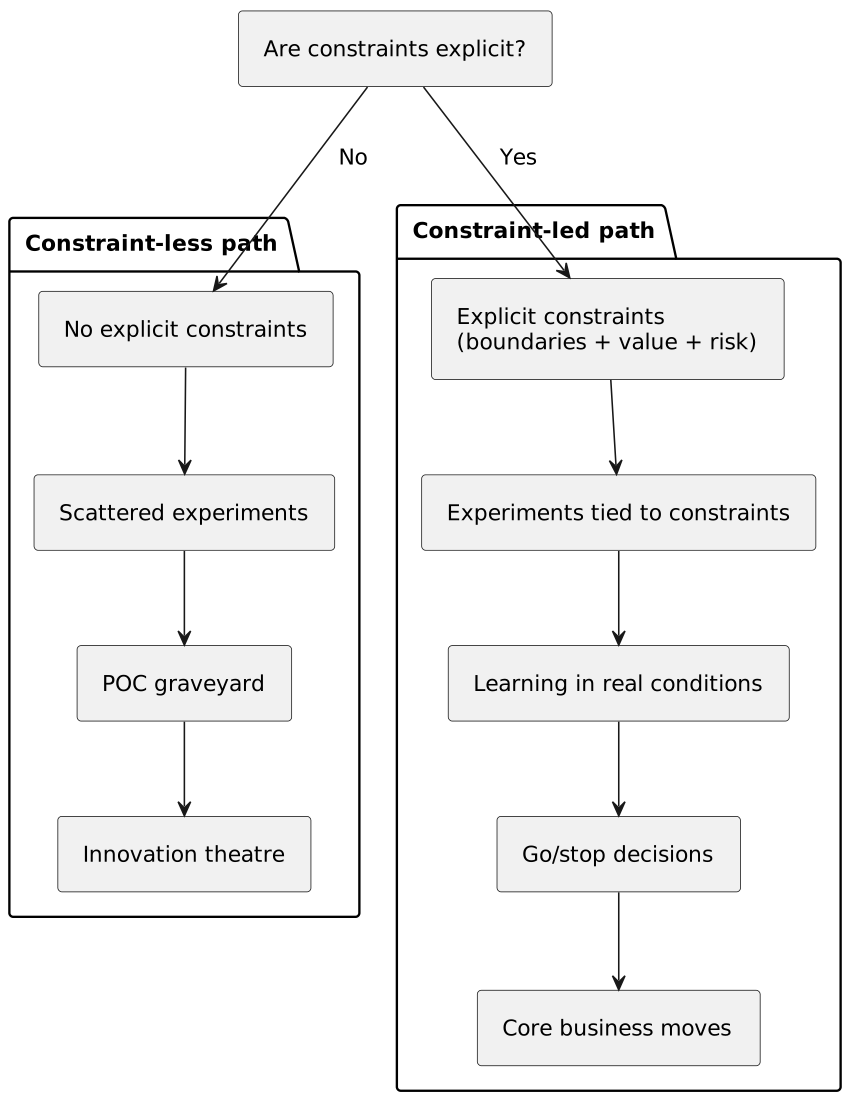
Innovation governance then reinforces the scatter. Portfolios are measured by the number of ideas, pilots, or features, not by how tightly they connect to a small set of constraints leadership has committed to move. With few kill criteria, initiatives linger, pile up, and compete for attention long after their learning value has peaked.
Finally, experiments are often decoupled from the real operational environment. POCs run in sandboxes with ideal data, extra support, and exceptions that do not exist in production. Because constraints are softened, the organization learns little about how the innovation behaves under real load, with real trade-offs — and scaling quietly stalls.
This is less necessary when leadership already has explicit constraints with real kill criteria and a forum that enforces them. It becomes critical when portfolios grow and teams optimize locally without a shared bottleneck.
What constraint-less innovation looks like
If you look closely at your innovation portfolio, certain patterns reveal the absence of clear constraints.
POCs. A growing “POC graveyard”: many pilots started, few scaled or retired decisively. Experiments are not anchored in specific constraints or success criteria; they get evaluated on technical promise or sponsor enthusiasm. A good first move is to require every experiment to state which constraint it addresses (cycle time, cost to serve, risk per unit of growth) and how impact will be observed at scale.
Portfolio. The portfolio feels crowded but impossible to summarize in one page. Bets are distributed across themes and technologies, but not concentrated on a small set of value levers or customer problems. A practical way to start is to re‑cluster initiatives by constraint and value stream, then deliberately prune work that does not clearly support the few constraints that matter most.
Decisions. Go/stop calls are driven by narrative and sponsorship more than by learning. There is no shared language for what “working” means and no thresholds for when to double down or stop. One simple move is to define decision rules per constraint (e.g., “we continue if we see a 20–30% improvement in X within Y weeks”) and hold reviews against these — not against slides.
Make constraints the spine of your innovation system
Suggested moves — pick one to try for 1–2 weeks, then review what you learned.
Name the few constraints that matter most
Ask: “If we could change only three constraints in how we create and capture value, which would they be?” Make them concrete (onboarding time, cost to serve, risk per unit of growth). This works because constraints turn innovation from “many activities” into “a few levers”, so learning compounds instead of scattering.
Start by writing the top three constraints on the first slide in your next portfolio forum and keep returning to them. Watch whether new initiatives can answer, in one sentence, “which constraint does this move?”
Reframe and prune the portfolio through constraints
For each initiative, write a one-line mapping: “Which constraint does this attempt to move, and how?” Then deliberately stop what doesn’t map. This matters because a portfolio that can’t be summarized can’t be governed; pruning is how you create focus.
Start by taking 30 initiatives and clustering them by constraint; kill or merge the bottom 20% with the weakest mapping. Watch for fewer POCs lingering without a decision — does the “POC graveyard” shrink?
Run experiments that respect reality (and review by constraint movement)
Design experiments close to production: real data, real channels, real operational limits — plus simple go/stop rules tied to the constraint. This works because if constraints are softened, you learn the wrong lesson and scaling stalls later.
Start by picking one constraint and defining a 4–6 week “learning sprint” with a test in the real environment and explicit kill criteria. Watch for evidence of constraint movement — and whether decisions get made based on learning, not sponsorship.
If innovation continues without explicit constraints, portfolios will stay busy and underwhelming at the same time. Teams will work hard on ideas that feel exciting locally but barely register at the level of the business model. Leaders will oscillate between enthusiasm for new initiatives and frustration that “nothing really changes”.
Experiment fatigue will set in. People will grow skeptical of yet another pilot or lab, because previous efforts produced impressive demos but little structural gain. The organization will drift toward innovation theatre — visible activity with minimal leverage — while competitors who know exactly which constraints they are attacking quietly pull ahead.
Which hard constraint would make your innovation portfolio sharper tomorrow?