
Low-code as a common language between business and technology
Low-code is not less code — it is more collaboration. It is the bridge between human knowledge and technical automation.
By turning business logic into visual components, low-code lets software learn from the people who use it and become an active part of organizational evolution.
Low-code is a shared language
Insight: Low-code is a shared language — more collaboration, not less code.
Low-code is not less code — it is more collaboration. It is the bridge between human knowledge and technical automation.
The idea of low-code is often reduced to speed, but its real value is in translation: it creates a common language between human thinking and digital behavior. When business people participate actively in building the system, software stops being something they merely “request” and becomes a space where they dialogue with technology.
This happens because handoffs erase context — and low-code reduces the distance between intent and executable behavior.
In one minute
- Low-code turns requirements into a shared model you can validate in days, not a document you interpret for weeks.
- This happens because visual modeling keeps tacit business knowledge in the room instead of losing it in handoffs.
- Start by co-modeling one high-rework flow with a mixed team and validating it weekly in executable form.
When intent turns into tickets, meaning gets lost
Most organizations still translate business intent into long documents or ticket descriptions. In that translation, much of the tacit knowledge — subtle rules, exceptions, and mental models — simply disappears.
The “business → IT” handoff becomes a one‑way transfer of text instead of a shared exploration of how the system should behave.
Visual models accelerate feedback (and reduce rework)
Low-code changes this dynamic because it brings visual modeling and shared components into the same room. When business and technology look at the same flows, screens, and rules in an executable form, ambiguity drops and feedback accelerates. The conversation shifts from “what did you mean in this requirement?” to “does this behavior on screen match how we actually work?”
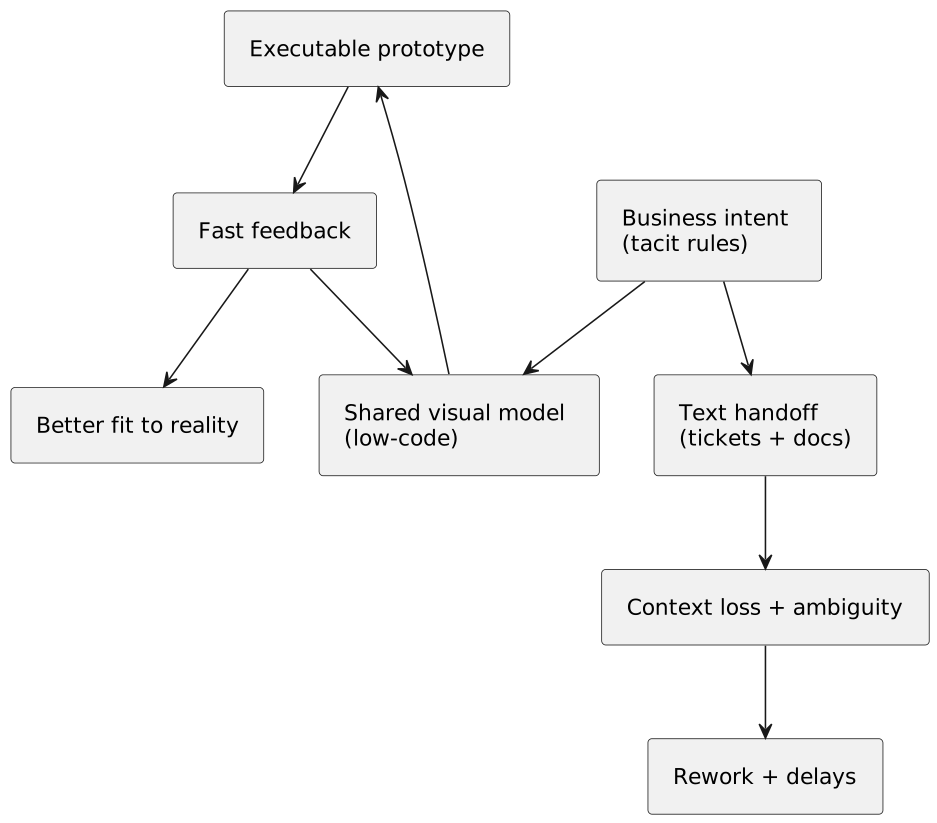
This is less useful when the domain is simple and requirements are stable. It becomes valuable when tacit rules and exceptions drive rework and the cost of translation is the bottleneck.
Where translation is creating rework
Translation costs leave fingerprints in the work itself — not in strategy decks. Look at the artifacts between business and delivery: documents, handoffs, and late validation cycles. When those artifacts multiply, low-code is being used as a delivery tool, not as a shared language.
Requirements. Requirements turn into static documents, and conversations freeze into artifacts that lose context. That’s the translation gap showing up as rework later. A good first move is to prototype in low-code together with the people who operate the process.
Handoffs. Deliveries get stuck in the business → IT handoff, with long queues for analysis, clarification, and testing. That’s shared language missing, replaced by interpretation. A practical way to start is to create shared components (UI and rules) and run short joint validation cycles.
Late validation. Errors get discovered late, when they are already expensive to fix. That’s feedback arriving after commitment. One simple move is to experiment, adjust, and validate in real time with stakeholders using executable models.
Turn requirements into shared modeling
Suggested moves — pick one to try for 1–2 weeks, then review what you learned.
Co-model the highest-rework flows
Map three flows with the highest rework and prototype them in low-code with a mixed business/tech team. This works because the fastest way to reduce rework is to keep tacit rules and exceptions visible while the model is still cheap to change.
Start by picking one flow and running weekly executable demos with the people who operate it. Watch rework rate and time from idea → validated flow.
Extract shared rules into versioned components
Extract common rules into versioned components (with technical review and quality gates). This matters because shared components prevent local divergence and keep the “common language” stable over time.
Start by identifying the top five repeated rules across flows and building one reusable component as a pilot. Watch for fewer duplicated implementations and faster change propagation across flows.
Measure learning, not just delivery
Measure time‑to‑validation and rework per flow, and use those metrics in prioritization. This works because low‑code’s value is feedback speed; if you don’t measure it, you’ll fall back to ticket throughput.
Start by adding one metric review in your weekly ritual (“what changed in time‑to‑validation this week?”). Watch whether the main question shifts from “what should we ask IT to build?” to “what are we going to model and validate together this week?”
Low-code is a mechanism for co-authorship: it turns development into a shared discovery process where business and technology learn together. The result is less rework, more clarity, and systems that better reflect how the organization truly thinks.
If we ignore this, chronic delays caused by requirement translation and rework will persist. Software will keep reflecting an outdated, partial understanding of how the business operates, and every evolution will demand another round of clarification, re‑implementation, and late discovery of errors.
In which flow will you invite the business to co-create using low-code?