
Low-code & No-code — evolution or revolution?
Low-code and no-code platforms are reshaping software development — accelerating delivery and bringing business and technology closer together.
The rise of LCNC platforms is redefining the role of developers and business teams, combining visual modeling, automation, and AI to create systems with more speed and governance.
LCNC expands capacity with governance
Insight: LCNC expands capacity with governance — otherwise it just scales chaos.
LCNC accelerates delivery and brings business and technology closer — without replacing engineering.
Low-code and no-code (LCNC) platforms combine visual modeling, automation, and increasingly AI to create systems with speed and control. The developer’s role changes: repetitive tasks move to models; human focus shifts to logic, architecture, and quality. Business teams stop just placing requests and start directly participating in construction, while engineering provides guardrails, security, and sustainable evolution.
This happens because LCNC changes where human attention adds the most value: less on repetitive wiring, more on architecture and quality.
In one minute
- LCNC increases the surface for contribution — but quality only scales with standards and guardrails.
- This happens because visual models collapse feedback loops and automation removes repetitive engineering work.
- Start with 2–3 pilots, define governance, and measure lead time and defects before you scale contribution.
More contributors, same accountability
As delivery pressure rises, the question becomes: how do you expand build capacity without turning software into chaos-by-many-authors?
LCNC is one answer — if engineering treats it as a platform capability with clear boundaries, not as a shortcut.
Models accelerate feedback; governance keeps it safe
Traditional development pipelines are optimized for handwritten code and long cycles of analysis, build, and test. Visual models dramatically reduce the time it takes to assemble and validate flows because people can see and manipulate behavior directly, instead of interpreting specifications.
As LCNC platforms evolve, reusable components and AI help generate base code, integrations, and even tests, freeing engineers from a long tail of repetitive work. With proper governance — standards, review practices, observability, and clear boundaries — quality can stay high even as more people contribute. The shift is less about “less code” and more about changing where human attention adds the most value.
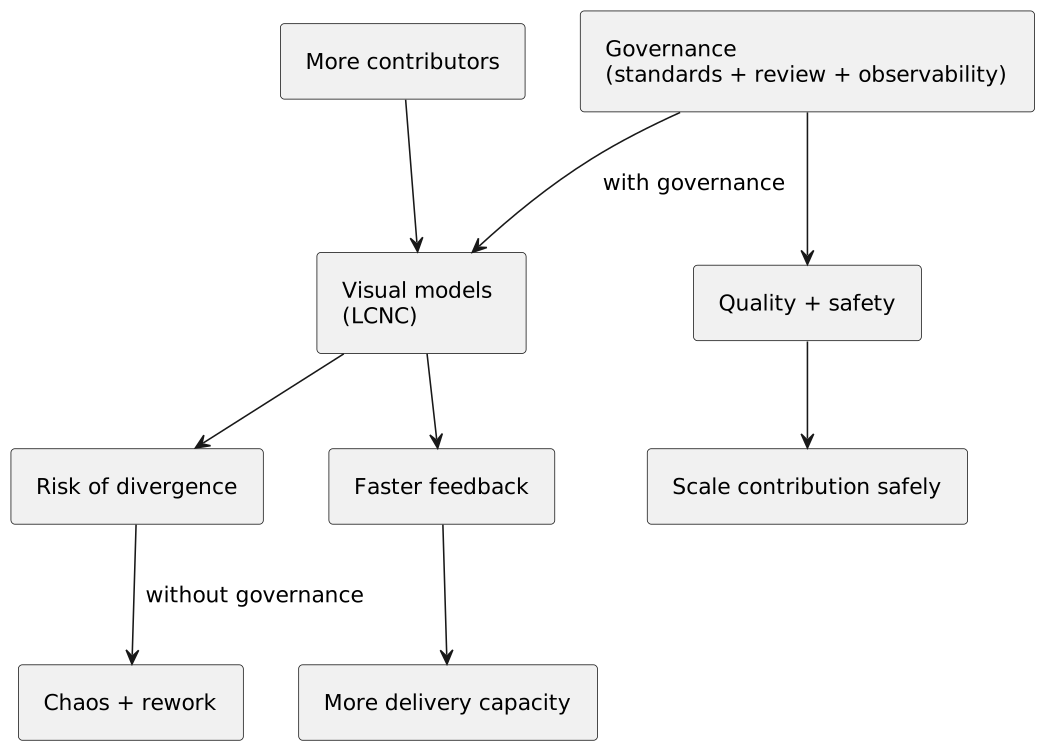
This works best when you choose low-irreversibility flows and keep strong engineering guardrails. It becomes risky when LCNC is used for high-assurance domains without clear standards, ownership, and off-ramps.
Where LCNC needs stronger governance
LCNC works when it increases contribution without multiplying chaos. The early signals show up in the backlog, in rework and defect patterns, and in how often teams collide over scarce engineering capacity. When the platform is missing guardrails, the organization pays in duplication, queues, and fixes.
Backlog. The backlog grows even as more people contribute — high engagement, low standardization. That’s contribution without reuse. A good first move is to standardize components and quality pipelines so teams reuse more and rebuild less.
Rework. Rework shows up after business validation because prototypes weren’t validated early in executable form. That’s feedback arriving too late. A practical way to start is to validate flows in model form before committing to traditional development.
Capacity. Teams constantly compete for scarce engineering capacity because repetitive wiring still depends on engineers. That’s a platform gap, not a motivation gap. One simple move is to move simple automations and integrations to LCNC under clear guardrails.
Scale contribution without scaling chaos
Suggested moves — pick one to try for 1–2 weeks, then review what you learned.
Start with 2–3 pilots (low/medium complexity)
Select 2–3 low‑ or medium‑complexity cases as LCNC pilots. This works because pilots reveal where models help and where engineering guardrails must be stronger.
Start by picking one workflow with clear inputs/outputs and low irreversibility. Watch lead time and defect rate versus the baseline.
Define governance and “off-ramps”
Define standards (components, security, observability) and clear off‑ramps to traditional code when needed. This matters because the platform must make the safe path the easiest path; otherwise shortcuts move outside governance.
Start by publishing a simple rubric: what can be built in LCNC, what must escalate, and what must be coded traditionally. Watch rework after validation and the number of exceptions/overrides.
Measure outcomes and scale the platform (not ad-hoc apps)
Measure lead time and defects before/after pilots, then scale reusable components and patterns. This works because the goal is distributed contribution with coordinated quality — not a zoo of one‑off apps.
Start by turning the top reusable rules/components into platform assets with review and versioning. Watch whether capacity expands without increasing incidents or fragmentation.
LCNC is not a shortcut to “code less”, but a new arrangement between business, engineering, and platform. When well governed, it expands capacity without sacrificing quality, security, or architecture.
If we ignore LCNC, the pressure to accelerate will not disappear — it will surface as shortcuts outside governance. Teams will either ship faster with little quality, accumulating debt and rework, or keep engineers trapped in repetitive tasks instead of designing resilient architectures.
Which flows in your team could move from handwritten code to visual models?