
Models instead of source code
When software is based on models, it stops aging and starts evolving alongside the business.
Shifting from source-code-first to model-first turns software into a living system, capable of continuously adapting to new technologies and business contexts.
Models let software evolve without losing identity
Insight: Models let software evolve without losing identity — behavior stays stable while technology rotates.
When software is based on models, it stops aging and starts evolving with the business.
All code ages, but a model can mature. Moving to model‑driven systems separates functional concepts from the technology that executes them — software becomes structured knowledge, not just lines of code. Instead of rewriting everything with each new stack, you preserve what the organization knows how to do well and only change how it is executed. Architecture stops being an obstacle and becomes a mechanism for evolution.
This happens because models preserve functional intent, while runtimes and infrastructure can evolve without rewriting the business itself.
In one minute
- Source code ties behavior to a specific stack; models preserve behavior while technology rotates underneath.
- This happens because business change and technology change outpace “rewrite cycles” — so coupling becomes fragility over time.
- Start by migrating one stable rule set into declarative models with explicit contracts to the runtime.
When every change starts to feel risky
In many systems, technical changes are delayed not because teams lack ideas, but because touching the codebase feels like touching a house of cards.
Model-first approaches create a different default: change the model (what the system should do) and swap/upgrade the technical shell (how it runs) with less fear of unintended side effects.
Coupling turns change into regression risk
Business rules and market conditions change faster than most platforms and frameworks. When rules are hard‑coded into a specific stack, every new requirement or technology shift forces teams to touch large amounts of code, carrying the risk of regressions and side effects. The result is an architecture that grows more fragile the longer it lives.
Model‑driven systems attack this fragility by preserving functional identity in a form that is independent of the underlying technology. Instead of expressing behavior only in source code, they capture it in declarative models and treat runtimes, frameworks, and infrastructure as interchangeable “technical shells”. Swapping that shell keeps the system alive without losing the context encoded in the model.
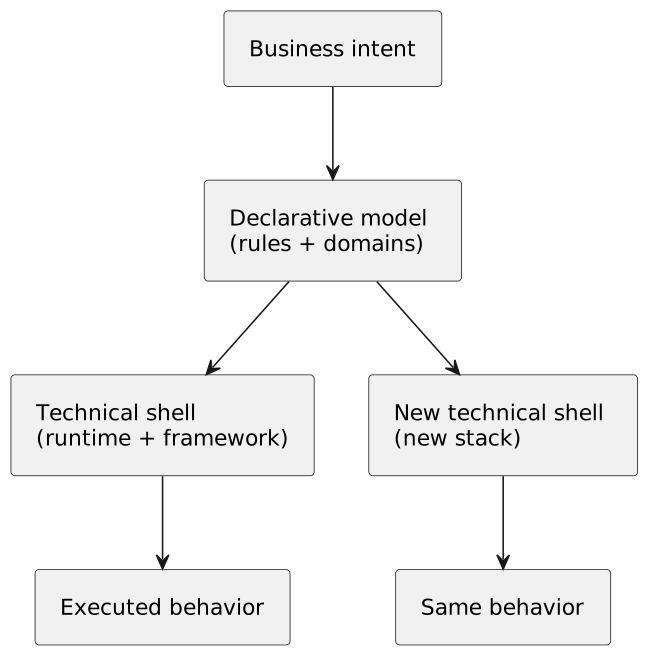
This pays off when you have stable rules with clear boundaries and repeated change pressure. It is weaker when the domain is highly volatile or the “model” cannot be governed with contracts and versioning.
Where model-first will pay off quickly
If model-first will pay off, it usually announces itself through friction: releases blocked by dependencies, portability projects that feel like rewrites, and refactors that sprawl. These are not “just engineering problems” — they are signals that business intent is trapped inside implementation details.
Release friction. Releases get blocked by fragile technical dependencies because functionality is glued to specific technologies. That’s business intent trapped inside implementation details. A good first move is to isolate rules into models and version contracts between model and runtime.
Portability pain. Porting capabilities to a new stack feels like rewriting, not migrating — low neutrality, high coupling. That’s the technical shell becoming the identity. A practical way to start is to introduce an abstraction/generation layer driven by models.
Refactor sprawl. Small functional changes require broad refactors across the codebase because business concepts and implementation details are structurally coupled. That’s change becoming regression risk. One simple move is to map domains and move rules into declarative models that can evolve independently.
Move one capability from code-first to model-first
Suggested moves — pick one to try for 1–2 weeks, then review what you learned.
Start with stable rules (model the essence)
Identify stable rules and migrate them into declarative models. This works because stable rules are where you can preserve business intent and reduce future rework the most.
Start by picking one capability with clear boundaries and writing the model in executable form. Watch how often changes require touching many modules versus updating a single model.
Define explicit contracts between model and execution
Define clear contracts between model and execution (generation, adapters, or interpreters). This matters because contracts prevent “model drift” and make portability intentional instead of accidental.
Start by versioning one contract and running it in parallel with the existing implementation for one flow. Watch for fewer regressions when upgrading frameworks or runtimes.
Measure adaptation time vs. technical effort
Measure functional adaptation time versus technical effort over successive changes. This works because model-first is an investment in future change cost; metrics make trade‑offs visible.
Start by tracking “time from change request → validated behavior” and “engineer hours spent on technical refactors”. Watch “full rewrite” conversations being replaced by discussions about evolving models and connectors.
Model‑first thinking is digital sustainability applied to architecture: it preserves what is essential in the business while allowing technology to rotate around it. Software stops being a rigid block and becomes an organism that learns without losing its identity.
If we ignore this, systems will continue to “break” at each major technology change. Functional knowledge will remain scattered across code, difficult to discover, preserve, and evolve. Every modernization cycle will feel like starting from scratch instead of building on what the organization already learned.
Which functionality could be the first to move from source code to model source?