Modernizing is rebuilding, not repainting
Real modernization happens when software architecture once again reflects how the business thinks and changes.
Modernizing is not just swapping technology, but restoring the ability to adapt — the real antidote to functional legacy.
Modernization is rebuilding plasticity, not repainting
Insight: Modernization is rebuilding plasticity, not repainting — restoring the ability to change well.
Real modernization gives software back the ability to think like the business.
Many legacy systems keep running but have stopped thinking like the business. The core legacy problem is functional: rules trapped in structures that cannot follow change. When architecture does not evolve with strategy, every new idea requires either hacks or a large project. In this context, modernizing means rebuilding the ability to change fluidly — not just adding a new visual layer on top of old models.
This happens because rebuilding change capability is harder than swapping tools — but it’s the only thing that compounds.
In one minute
- Legacy is often functional: the system runs, but its logic can’t move with strategy.
- This happens when business rules are coupled to specific tech and evolution is treated as episodic projects, not a living cadence.
- Start by extracting one domain’s rules into a stable layer/model and pairing it with a run-change rhythm and metrics.
When every strategic change becomes a “project”
In many organizations, you can feel functional legacy in the roadmap: small strategic changes translate into big cross-team coordination, long lead times, and risky releases.
The result is a pattern of “rescue modernization”: a large initiative refreshes part of the stack, the system hardens again, and the next change triggers another wave.
Coupling turns evolution into surgery
Legacy builds up when business logic is tightly coupled to specific technologies. Rules, workflows, and decisions are embedded deep inside code, databases, and integration scripts that were never designed to move at the speed of strategic change. Every new idea then has to fight against structural inertia.
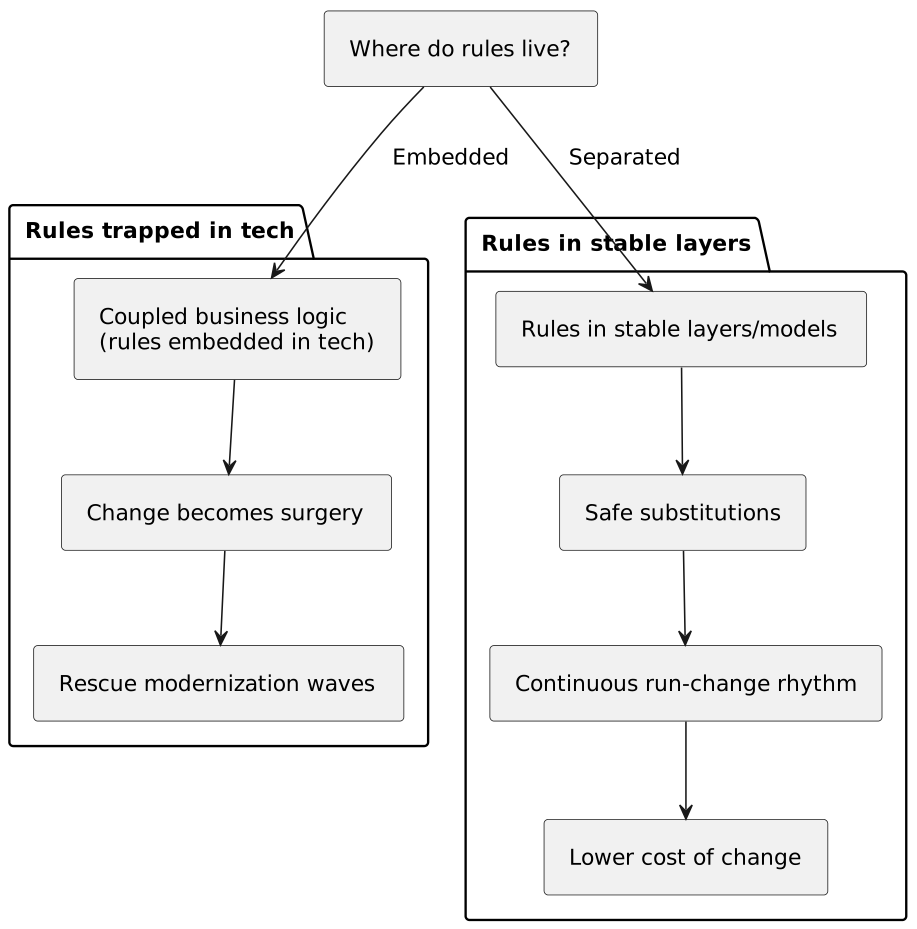
On top of this, many organizations still treat evolution as a series of isolated “projects”, not as an ongoing capability. There is no technologically neutral, “living” architecture designed to change; there are just waves of initiatives that temporarily refresh parts of the stack. Between waves, the system hardens again, and modernization becomes something extraordinary rather than part of the normal rhythm of work.
This is less necessary when a system’s constraints are truly local and small repairs restore safety and speed. It becomes necessary when the structure itself encodes the wrong assumptions and every change amplifies coupling.
Where the system stopped reflecting the business
You can tell when a system stopped reflecting the business by watching what it does to ideas: how long they take to become features, how fragile change feels, and what dominates the roadmap. These signals show up in cycle time, incident patterns, and in the stories teams tell about “small” changes.
Ideas. Small ideas take too long to become features because the system no longer reflects how the business currently thinks. That’s functional legacy turning strategy into coordination. A good first move is to separate rules from technology and reduce handoffs between business and engineering.
Fragility. Small changes cause large side effects because structural coupling is high and modularity is low. That’s evolution turning into surgery. A practical way to start is to modularize by domains with clear contracts and protect stable cores from volatile details.
Roadmap. The roadmap is dominated by urgent maintenance and incident recovery because there’s no continuous evolution cycle — only firefighting. That’s modernization showing up as emergencies. One simple move is to establish a run‑change rhythm with explicit flow and quality targets.
Rebuild change capability, then modernize continuously
Suggested moves — pick one to try for 1–2 weeks, then review what you learned.
Extract business rules into stable layers/models
Map domains and extract rules into layers or models that represent how the business reasons about its work. This works because functional legacy is rules trapped in structures; separating intent from implementation restores plasticity.
Start by picking one domain and identifying the 10 rules that change most; move them into a clear, versioned layer/model. Watch whether changes stop requiring broad refactors across unrelated parts of the system.
Install a run-change rhythm with explicit metrics
Establish an evolution cadence (run‑change) with metrics such as lead time, deployment frequency, and defect rates. This matters because if evolution isn’t in the calendar, it will only happen in emergencies.
Start by setting a weekly or biweekly evolution review and choosing 2–3 metrics to track for 30 days. Watch for less firefighting and a roadmap that regains space for strategic change.
Plan substitutions that preserve functional identity
Plan technical substitutions so you can swap infrastructure and frameworks without breaking functional identity. This works because modernization should be a series of safe swaps, not a full rewrite that restarts learning.
Start by choosing one dependency (database, integration layer, runtime) and defining a migration path that keeps rules stable. Watch for fewer “big bang” modernization projects and more incremental, reversible changes.
Modernization is about rebuilding plasticity — not repainting the surface. When architecture once again mirrors how the business thinks, innovation becomes model adjustment, not risky surgery.
If we ignore this, core systems will continue to block innovation while silently accumulating debt. Modernization will remain an emergency response instead of becoming the default way the organization changes.
Where does your system today stop reflecting how the business really thinks and decides?