
Provoke innovation
Automation is not about replacing humans — it is about freeing creative potential to continually reinvent work.
Innovation happens when technology and culture come together to build, test, and learn continuously.
Automation creates slack for innovation
Insight: Automation creates slack for innovation.
On Monday, someone asks for “more innovation.” By Thursday, the same team is still copying data between tools, reconciling spreadsheets, and chasing approvals. The problem isn’t a lack of ideas. It’s that all the time and attention that could test ideas is trapped in repetition.
Automation is not innovation by itself. It’s how you create slack — time and cognitive bandwidth — so teams can run small experiments and learn from reality.
This happens because innovation follows a simple loop — the Slack-to-Learning Loop: remove repetition → create slack → run experiments → capture learning → redesign the work.
In one minute
- Innovation stalls when teams have ideas, but no slack and no way to turn ideas into tests.
- Automation creates slack; experiments convert slack into learning; learning redesigns the work so you can automate the next constraint.
- Start with one high-frequency manual step, measure time saved, and reinvest part of that time into one hypothesis test next week.
Backlogs can be full and still be stagnant
It’s common to have a backlog that looks “healthy” and still be stagnant. When every sprint is fully committed to delivery and operations, novelty becomes a quarterly initiative instead of a daily habit. The organization has motion, but little learning.
You see it in meetings too: leaders ask for “new bets”, but the calendar tells a different story — reviews, approvals, and status updates leave no protected space to try anything small and safe.
The Slack-to-Learning Loop (and where it breaks)
Innovation needs two conditions that rarely coexist by default: slack (time + attention) and a conversion mechanism (experiments with feedback). Automation can provide the first condition, but without the second, the “freed time” gets reabsorbed by more operations.
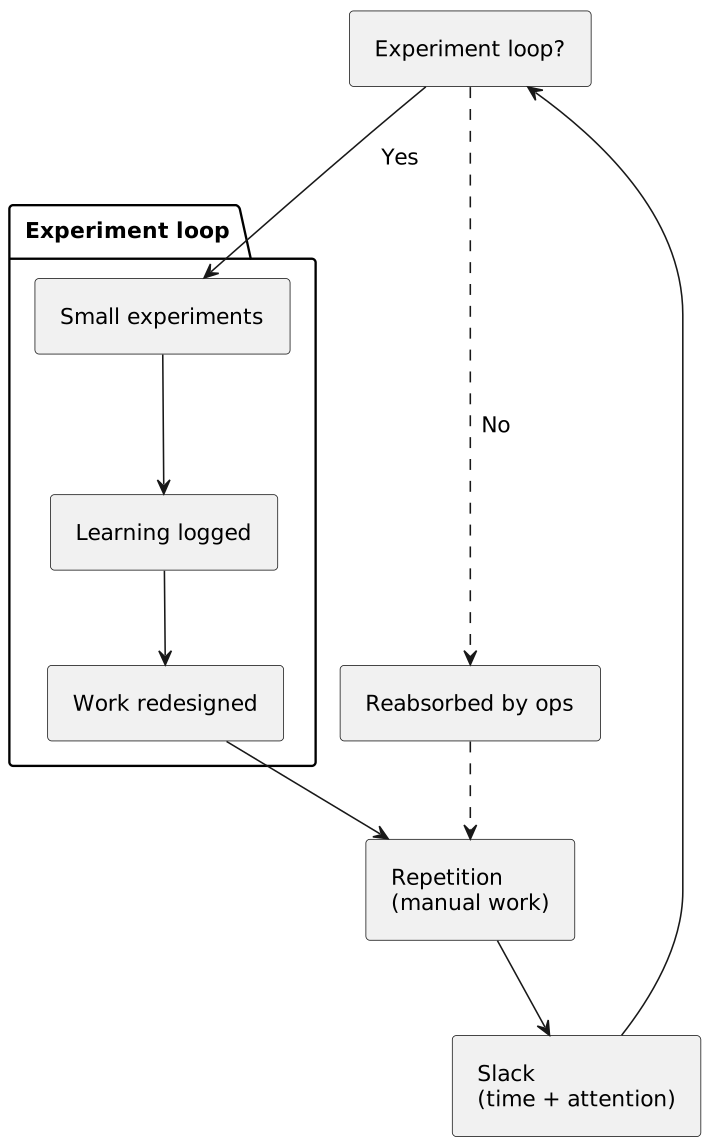
Slack is a constraint. When teams spend hours on recurring manual work, they protect themselves with routines, not exploration. Even if you add more ideas, there’s no capacity to test them.
Experiments are the converter. A hypothesis, a timebox, and a success metric are how ideas stop being opinions and become learning. Without explicit experiments, innovation remains a slide and a story.
Learning must be captured. If results aren’t logged and reviewed, you can’t compound. The organization repeats the same debates because it can’t remember what it already learned.
In short: automation creates slack, but only the Slack-to-Learning Loop turns that slack into innovation.
This is less useful when teams already have protected slack and a habit of turning it into experiments and learning. It matters most when operations absorbs every reclaimed minute and learning has no place to stick.
Where slack is leaking (or missing)
Slack isn’t something you announce; it’s something you can see in the artifacts of everyday work. Look for where time disappears: in recurring manual steps, in calendars with no protected discovery slot, and in whether experiments exist as learning logs or as slides. These signals tell you if automation is creating learning capacity — or just making the treadmill faster.
Manual steps. Runbooks, handoffs, or “temporary” spreadsheets contain the same manual steps every week (copy/paste, reconciliations, approvals-by-email). Repetition is consuming the slack that innovation needs. A good first move is to pick the highest-frequency manual step, automate the smallest safe slice, and measure time/error before and after.
Calendar. Discovery time is always the first thing to get cancelled, and the team can’t point to any protected slot for exploration. The organization wants innovation, but doesn’t fund it with time. A practical way to start is to reserve one visible slot per week and treat it as capacity (not “extra”). Track whether it survives the sprint.
Experiment artifacts. Ideas exist as epics and decks, but not as hypotheses with metrics, timeboxes, and a decision rule. Ideas are not being converted into learning. One simple move is to require a lightweight experiment card: hypothesis, metric, timebox, and what you will decide based on the result.
Reabsorption. After automation work, throughput increases, but teams can’t name what stopped — “we got faster” without any reclaimed time being visible. Slack is being reabsorbed by demand, not reinvested into discovery. A useful next step is to define a “slack dividend”: reinvest a fixed portion of reclaimed time into experiments for 1–2 weeks, then review outcomes.
Turn reclaimed time into compounding learning
Suggested moves — pick one to try for 1–2 weeks, then review what you learned.
Automate one recurring manual touchpoint (with instrumentation)
Identify one recurring manual step that appears every week and automate the smallest safe slice. This matters because slack starts with removing repetition, but you only trust slack you can measure. Start by measuring the baseline (minutes per run, errors, rework), then automate one step and re‑measure. Watch time reclaimed, fewer manual touchpoints, and fewer “oops” fixes.
Protect a slack dividend
Reinvest part of the reclaimed time into discovery on purpose. This matters because if you don’t protect slack, operations will absorb it instantly. Start by putting one protected slot on the calendar and setting a simple rule (e.g., “50% of reclaimed time goes to experiments this sprint”). Watch whether protected time survives and whether new learnings show up in planning.
Run one hypothesis test per sprint (and keep an experiment log)
Run at least one experiment per sprint with a hypothesis, metric, and decision rule. This works because experiment cadence is how slack becomes learning, and learning becomes redesign. Start by creating a tiny experiment log (1 page is enough) and reviewing it in the retro. Watch experiments completed, decisions changed by evidence, and fewer repeat debates.
If you’re in a reliability fire, the goal isn’t “innovation time” — it’s reducing the repetition that keeps dragging you back into the fire. Automating the work that recurs is often the fastest path back to slack.
What will you automate today to free time for experimentation?