Psychological safety is the foundation of self-organization
Psychological safety makes self-organization real inside clear guardrails.
When psychological safety is low, autonomy becomes escalation and executives become bottlenecks. When it’s high, teams decide in public, learn fast, and keep decisions close to the work.
Autonomy collapses when safety is low
Insight: Autonomy collapses when safety is low.
Self-organization looks confident in slide decks. In the executive room, it often shows up as a queue.
It’s the weekly operating review. Someone added a slide a few months ago called “Escalations” because the list kept growing: a pricing exception that “needs sign‑off”, a customer message that “needs alignment”, a risk trade‑off that “should go to leadership”, a release that “can’t move without approval”. None of these are board‑level decisions, but they keep drifting upward anyway.
The room isn’t confused. It’s cautious. “We wanted alignment,” someone says — and everyone understands what that usually means: cover. The elephant in the room isn’t competence. It’s consequences. When the first question after an imperfect outcome is “Who approved this?”, escalation becomes the safest move.
Sometimes a leader breaks the spell: “Decide. We’ll learn after — and we’re not doing a blame hunt.” Sometimes no one does, and the organization learns a different lesson: don’t be the person who decides in public.
That is why psychological safety sits underneath self-organization. Psychological safety means people expect they can speak up, challenge, and make a responsible call without being punished or humiliated. Self-organization means decisions happen close to the work, within clear guardrails, without waiting for permission on every trade‑off. And guardrails are the explicit boundaries that say what teams decide by default — and when they must escalate.
Leaders shape safety by shaping consequences in high‑stakes moments. Autonomous teams also create safety locally: they share ownership, keep learning public, and make it normal to name the elephant early. But local safety won’t survive if the wider system still rewards silence and punishes initiative.
If this feels familiar, stop repeating “empowerment” and start changing the conditions that make it safe to decide in public. This happens because autonomy without protection turns ordinary trade‑offs into personal risk, so the system rationally chooses escalation.
In one minute
- Under pressure, autonomy collapses when being “the decider” carries personal cost. The safest move becomes “let’s align”.
- If guardrails are vague (or reversibility is low), escalation becomes the only safe boundary — even for reversible calls.
- Reframe: the first question after a miss becomes governance. Replace “Who approved this?” with “What did we learn?” — and protect the first responsible call, even if it wasn’t your preferred call.
Under pressure, decisions drift upward
Most “autonomy problems” don’t start in delivery teams. They start in the decision forums where consequences are assigned.
Picture a review meeting after anything that surprises the system: a missed target, a customer escalation, an audit finding, a reliability issue. Before anyone talks about root cause, everyone listens for the first question — because that question teaches what is safe.
Low safety sounds like: “Who approved this?” and “How did we not know?” Higher safety sounds like: “What did we learn?” and “What will we change so this is easier next time?” The difference is subtle, but the behavior it trains is not.
Over time, those questions decide whether people surface uncertainty early or hide it until it’s undeniable. When the personal cost of being wrong is high, escalation looks like professionalism — even when the decision is reversible and the team has the context.
Autonomy without protection becomes escalation
None of this is irrational. People do what keeps them safe in the system you’ve built.
Here’s a simple mental model: self-organization stays healthy when three things reinforce each other — safety, guardrails, and reversibility. Safety makes it socially safe to decide in public. Guardrails make it structurally safe (defaults and escalation triggers are explicit). Reversibility makes it economically safe (being wrong is survivable because you can learn and roll back). When any one of these is missing, escalation is the stable fallback.
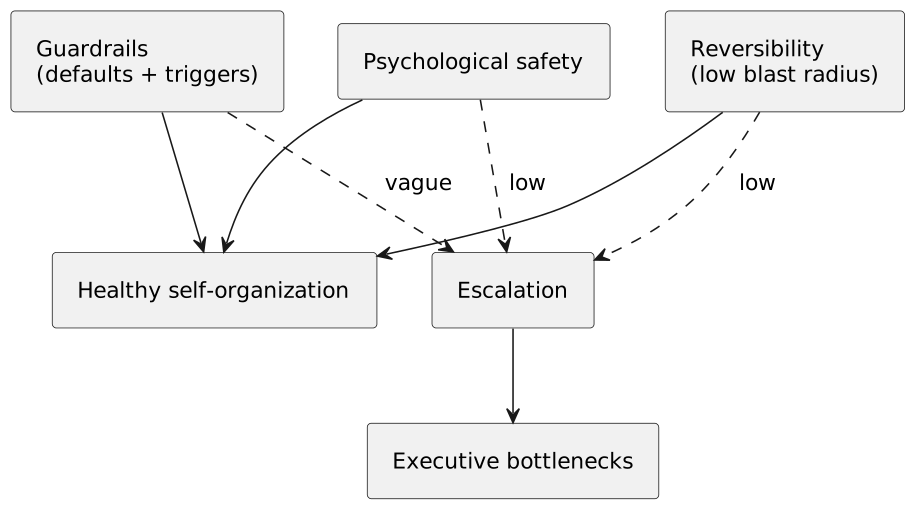
Responsibility moved, protection didn’t. Autonomy makes decisions visible — which is the point — but if mistakes are treated as personal failure, people protect themselves. One harsh review meeting can train escalation for months.
Boundaries are unclear or unstable. If guardrails are implicit — or overridden when inconvenient — teams learn that the only safe boundary is escalation. If yesterday’s “default” becomes today’s exception, it won’t feel safe.
Irreversibility makes every call feel career-defining. Big, opaque changes raise the cost of being wrong. When reversal is hard, every decision feels like a bet. Reversible change lowers fear and makes learning possible.
This pattern is weaker when guardrails are stable and decisions are highly reversible. It becomes acute when stakes are high, reversibility is low, and consequences are personal — so escalation becomes the rational default.
How to spot low psychological safety
When you want to know whether psychological safety exists, watch what happens when stakes rise. Safety is visible in decision flow, learning behavior, and how tensions surface — not in posters or values decks. Look at escalation logs, meeting agendas and minutes, incident/audit reviews, and the “approval load” hidden in delivery flow.
Decisions. Teams ask for approval on reversible decisions, and choices keep bouncing upward even when the people closest to the work have the context. Escalation protects reputations, so it becomes the default — even for reversible calls. A good first move is to start with one decision type: set a default (“team decides”), write 2–3 escalation triggers, and keep a simple escalation log for 30 days. Tighten the boundary using real cases.
Learning. Experiments happen quietly, learning is shared only after success, and reviews feel performative. The organization says “learn fast” but still treats failure as embarrassment, so learning moves underground. A practical way to start is to ban “who approved?” in learning forums and ask: “what did we learn, what do we change, who needs support?” Share learning weekly, not only wins.
Tension. Disagreement shows up late as passive resistance, side conversations, or escalations — rather than early as constructive debate. Challenging peers or leaders is socially risky, so tensions accumulate until they become crises. One simple move is to give trade‑offs a home: a recurring forum with facilitation and a simple agenda (surface tensions, decide, update agreements).
Make it safe to decide and learn in public
Start where the elephant lives: in the forums where consequences are assigned. Leaders make it safe to speak; teams make it normal to speak. Then treat guardrails as a learning tool: start narrow, observe where people still escalate, and refine the boundary from real cases. You don’t need a crystal ball; you need a default and the discipline to iterate.
Rewrite the leadership script (make safety visible)
In reviews, replace “Who approved this?” with “What did we learn?”, “What will we change?”, and “Who needs support?” — and thank the messenger. This matters because the first question after a miss becomes governance and trains either escalation or learning. Start by picking one standing forum (operating review, incident review, audit review) and explicitly committing to “no blame hunt for responsible calls inside guardrails” for 30 days. Watch whether uncertainty and bad news show up earlier and whether escalations for minor trade‑offs start declining.
Pick one decision and stop escalating it (make guardrails explicit)
Choose a frequent, reversible decision (rollout timing, customer messaging within a limit, exceptions under a threshold) and set a default (“team decides”) plus 2–3 escalation triggers. This matters because guardrails remove ambiguity about what is safe to decide locally. Start with a two‑week pilot with one team and keep a simple escalation log (what escalated, why, what was missing). Watch escalation volume and cycle time for that decision type — does the queue shrink without increasing surprise incidents?
Make being wrong cheaper (increase reversibility)
Require observable, reversible change (small releases, safe rollbacks, feature flags, clear monitoring) for decisions inside guardrails. This works because reversibility lowers the perceived career cost of deciding and makes learning real. Start by picking one risky decision type and defining a “safe‑to‑try” version (smaller blast radius, explicit rollback). Watch how often teams can reverse within hours/days and what that does to decision speed and learning cadence.
It also explains why self-organization fails without orchestration when autonomy is left to fend for itself.
The goal is not a “perfect culture”. The goal is a system where responsible decisions happen close to the work, learning is shared in public, and leadership attention is reserved for the few truly irreversible trade‑offs.
There’s a useful reframe here: escalation is often a sign of care. People escalate when consequences are unclear and they don’t want to harm customers, the business, or each other. Even better is when that care has a safer channel: explicit guardrails, reversible moves, and review forums that protect responsible calls.
The window matters. The longer you wait, the more escalation becomes habit, the more executives become default bottlenecks, and the harder it gets to surface uncertainty early — exactly when you need it most.
Start small: pick one boundary, publish the default, and protect the first responsible call. Then use one diagnostic question to guide the next iteration:
Where does “Who approved this?” still drive escalation in your organization?