The role of software in the age of digital twins
Digital twins are more than virtual replicas — they are ecosystems of continuous learning between the physical and digital worlds.
Real innovation lies in software’s ability to observe, represent, and adapt to the real behavior of the business.
Digital twins turn data into learning loops
Insight: Digital twins turn data into learning loops.
Digital twins are systems that learn from the real world and feed continuous improvement back into operations.
The value is not in the sensors themselves, but in the link between data, context, and decision. By turning operational data into living models, every physical event becomes a digital insight — and each insight feeds back into the operation. A good digital twin is not just a visual replica; it is a living laboratory where the organization experiments, learns, and adjusts the behavior of the physical system with lower risk and greater precision.
This happens because a digital twin is not a dashboard — it’s an improvement system with memory and action.
In one minute
- Data doesn’t change behavior; decisions do — and twins connect data to decisions through feedback loops.
- This happens when models stay “alive”: they observe, compare, decide, act, and learn continuously.
- Start by choosing one critical decision and building the smallest control loop around it.
More measurement, same decisions
Organizations have never collected as much data as they do today, yet many decisions still rely on intuition and partial views. When instrumentation doesn’t change decisions, it becomes an expensive mirror.
Twins become valuable when they close the gap between “what we think is happening” and “what’s actually happening” — and when they turn that gap into a learning routine.
Twins close the observe→decide→act loop
Digital twins close the physical↔digital loop by combining observability with feedback. They continuously capture what is happening, compare it to expected behavior, and feed discrepancies into an improvement cycle. Without this loop — observe, decide, act, and learn — even sophisticated instrumentation becomes little more than an expensive dashboard.
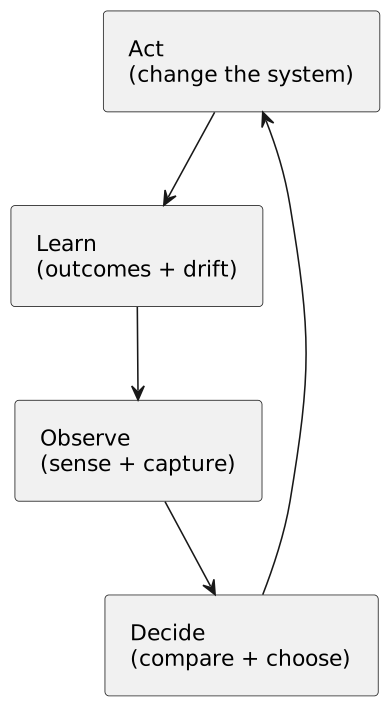
This is weaker when you can’t act on signals or when decision forums don’t change behavior. It becomes powerful when one clear decision loop exists and the organization can turn observations into policies, playbooks, and action.
Where twins are still “just dashboards”
A twin that stays a dashboard creates curiosity, not control. You can spot it by tracing the path from metrics to decisions to actions — and noticing where the chain breaks. The evidence is usually sitting in decision forums, incident reviews, and the absence of operational playbooks.
Decision. Metrics exist, but decisions do not change. Data is disconnected from the decision cycle. A good first move is to tie insights to policies, playbooks, and operational experiments.
Incidents. Incidents repeat the same patterns. The system has no memory and no feedback into how it operates. A practical way to start is to model events and implement automated responses with human review.
IoT. IoT projects show little tangible impact. They optimize data collection instead of learning and control loops. One simple move is to design control loops (observe → decide → act) with explicit success metrics.
Build one decision loop end-to-end
Suggested moves — pick one to try for 1–2 weeks, then review what you learned.
Pick one critical decision (and its indicators)
Map one critical decision and the indicators that should inform it. This matters because twins are only valuable when they change decision quality and speed. Start by choosing one decision forum and writing the default decision plus the trigger that changes it. Watch whether decisions change in response to signals (not only after incidents).
Model events and define responses (human + automatic)
Model events and define responses (automatic and human), including thresholds and playbooks. This matters because without explicit responses, insights remain “interesting” but operationally inert. Start by defining 3 event types, 3 thresholds, and a simple playbook for each. Watch for fewer repeated incident patterns and faster detection-to-response time.
Measure loop impact (and improve the model)
Measure the impact of each improvement loop (time, cost, quality, safety) and refine the model. This works because twins are learning systems; the model should evolve with reality. Start by picking one metric and reviewing it weekly alongside model drift or exception rate. Watch the distance between model and reality shrinking over time.
Digital twins connect reality and software in a continuous cycle of observation, decision, and action. Coherence between model and reality is what turns data into sustainable operational advantage.
If we ignore this, investments in data, sensors, and IoT will continue to pile up without meaningful operational change. The organization will have more measurements and visualizations, but decisions, risks, and costs will behave as if nothing had changed.
Which critical decision in your operation do you want to make more precise with a digital twin?