Shadow IT is intelligence in action
Shadow IT is not the enemy — it is a symptom of an organization seeking innovation faster than official IT can respond.
Instead of fighting Shadow IT, modern organizations use it as a compass to identify where the business innovates faster than technology can keep up.
Shadow IT is intelligence in action
Insight: Shadow IT is intelligence in action — a demand signal, not an enemy.
Shadow IT is not an enemy — it is a signal of where the business creates value faster than official IT.
The problem is not improvisation itself; it is keeping it hidden, fragile, and without a path to scale. When plugged into a platform with guardrails, improvisation becomes a scalable product. When IT sees Shadow IT as a learning field rather than a threat, it becomes a living map of business needs and a lab for new solutions.
This happens because suppression doesn’t remove the need — it only removes visibility and safety.
In one minute
- Shadow IT is demand discovery: it shows where the business is forced to improvise to keep value flowing.
- This happens when official delivery can’t match speed and there’s no safe path for “local hacks” to become supported products.
- Start by mapping the highest-value workarounds, then give them a platform lane with clear guardrails and an integration path.
Improvisation keeps the business running
Most Shadow IT is not created for rebellion. It’s created to ship something customers need, close an operational gap, or keep a critical flow moving when the official roadmap can’t respond in time.
You can see it in spreadsheets, lightweight automations, and “temporary” SaaS that quietly becomes permanent. The key question is not “how do we stop it?” but “how do we make what works visible, safe, and scalable?”
Speed without a landing zone creates fragility
Shadow IT appears when the need for speed outpaces the capacity of official backlogs. Business areas cannot wait for a future slot in the roadmap to test an idea, serve a client, or close an operational gap. They improvise with the tools at hand — spreadsheets, SaaS, scripts — because the alternative is doing nothing.
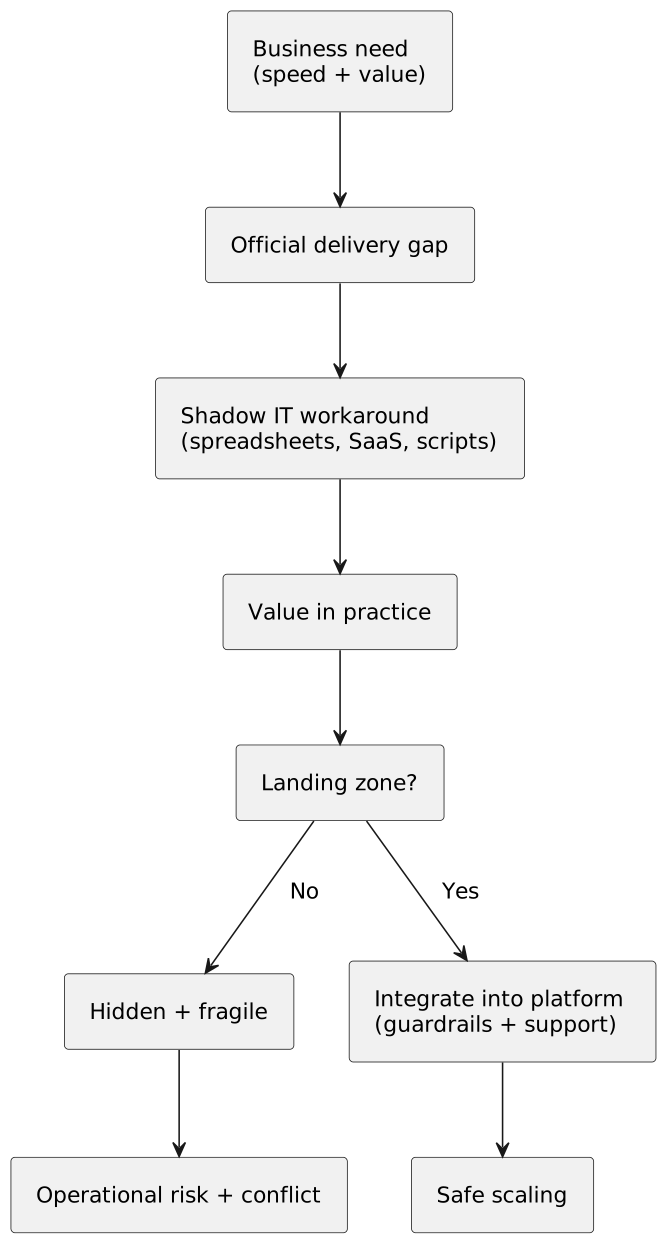
In many organizations, there is no platform or set of guardrails to turn these “hacks” into products. Improvisation stays local, fragile, and invisible. On top of that, fear of losing control often replaces the harder work of updating control. Instead of redesigning policies, architecture, and governance to absorb this intelligence, the organization tries to suppress it — and pushes it further into the shadows.
This pattern is weaker when official delivery has a fast, safe landing zone for local solutions. It becomes acute when compliance risk is high and workarounds keep critical flows running in the shadows.
Where Shadow IT is trying to tell you something
You can usually spot intelligent Shadow IT by looking at where workaround solutions quietly keep the business running.
Spreadsheets. You see many spreadsheets and parallel automations keeping critical flows alive. That’s legitimate demand without an adequate platform. A good first move is to offer an official path (platform + security + support) for these solutions to migrate.
Fragility. Useful solutions break easily because minimal engineering is missing: quality, observability, resilience. That’s what it looks like when value exists without a landing zone. A practical way to start is to apply lightweight engineering support and guardrails to what proves valuable.
Conflict. Conflicts between IT and business areas become frequent because the policy is blocking instead of guiding and integrating. Suppression turns a learning field into a trust problem. One simple move is to create a clear policy for integration and migration from Shadow IT into official platforms.
Turn improvisation into strategy (safely)
Suggested moves — pick one to try for 1–2 weeks, then review what you learned.
Map the workarounds that create real value
Map parallel solutions with high usage and visible value, and treat them as demand discovery rather than policy violations. The highest‑usage workarounds show where the organization is already paying the cost of “unofficial” just to keep value flowing.
Start by identifying the top 10 workarounds (by users, revenue impact, or operational criticality) and classifying them by risk and support needs. You should see fewer “unknown owners” and fewer critical flows dependent on single points of failure.
Provide a platform lane with guardrails
Define a platform lane and guardrails (security, data, quality) where these solutions can land and evolve. Without a landing zone, value stays trapped in fragile local hacks and the organization can’t learn safely from what the business is already proving.
Start by publishing a simple policy: “if it meets X and Y, we will help you integrate and support it.” Watch for more workarounds moving from hidden to visible, supported paths.
Migrate what works and retire what doesn’t
Migrate what works onto the platform and retire what does not add value. Scaling requires consolidation; otherwise overlapping solutions accumulate and operational risk grows in the background.
Start by picking one high‑value workaround and migrating it end‑to‑end with an explicit owner and an integration plan. Look for reduced rework, fewer incidents, and declining conflict between IT and business areas.
Shadow IT is intelligence in action waiting for structure. Studying, integrating, and structuring these solutions turns improvisation into strategy without suffocating teams’ creative capacity.
If Shadow IT remains invisible and untreated, operational risk and rework will grow in the background. Policies focused only on blocking will suffocate exactly the creativity and proximity to the customer that Shadow IT reveals, instead of channeling it into safer, scalable paths.
How can your company turn improvisation into strategy in a safe and scalable way?