
Time-proof software
A system’s durability does not come from avoiding change, but from its ability to change well.
Separating functionality from technology creates resilient software that can evolve without losing its business identity.
Durability is the ability to change well
Insight: Durability is not the absence of change — it is the ability to change well.
Separating functionality from technology preserves business identity while execution evolves. When functional identity is preserved, technical change becomes routine instead of crisis. Instead of fearing upgrades, the organization starts to see them as part of the normal evolution flow, because it understands what is structural and what is replaceable.
This happens because clarity + safety turns modernization from “surgery” into routine maintenance.
In one minute
- Durable systems separate what must stay stable (rules) from what will rotate (tech).
- This happens because business change is slower than platform change; coupling turns upgrades into risk.
- Start by making one boundary explicit and adding tests/observability around it.
When upgrades feel like existential risk
In many organizations, stack upgrades are postponed not because the value is unclear, but because the system’s impact is unpredictable.
Time-proof software reduces that fear by making boundaries and contracts explicit, so teams can change the technical shell without harming business identity.
Stable rules, volatile technology
Every organization carries a mix of stable rules and volatile technologies. Customer expectations, regulations, and core business logic tend to change more slowly than frameworks, libraries, and infrastructure. When these two layers are tangled together, each technical shift threatens to damage something essential.
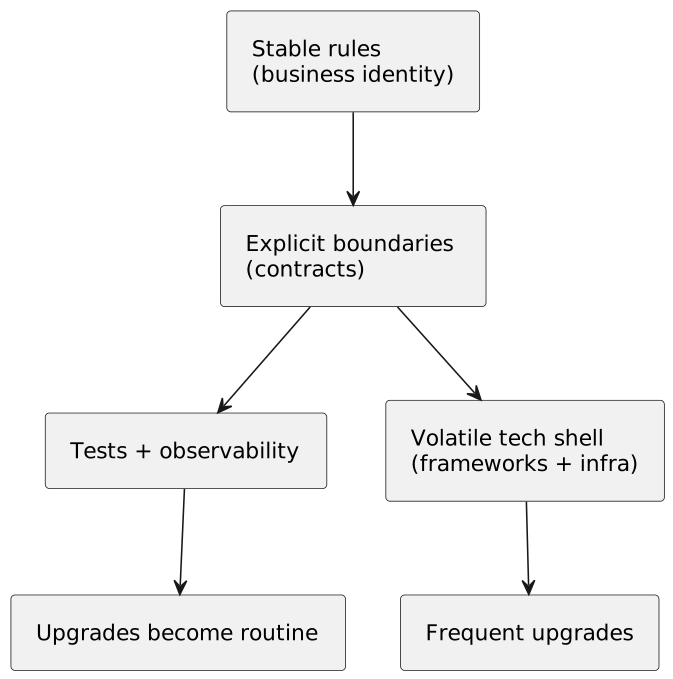
Time‑proof architectures deliberately separate what must remain stable from what can change frequently. Good abstractions turn evolution into continuity, not rupture: they keep functional knowledge in places that can mature, while allowing the technical shell around it to rotate. Over time, systems that learn in this way accumulate functional knowledge instead of losing it at every rewrite.
This is easier when domains are well-bounded and behavior can be tested at the edges. It gets harder in tightly coupled legacy where boundaries are unclear and safety is missing — which is exactly why you start with one small seam.
Where boundaries are still unclear
When boundaries are unclear, upgrades feel like bets. The clues show up in how risky routine updates become, in how long projects must run to change something small, and in the fear that accumulates around touching “core” systems. These are symptoms of identity and technology being glued together.
Risky “routine” updates. A minor dependency bump triggers a fire drill because rules are encoded in framework behavior and nobody can predict the blast radius. Through the lens above, that’s what it looks like when identity and technology are still glued together. A good first move is to pull one small slice of business rules behind a contract and lock it down with a handful of behavior tests.
Long projects to change small things. A simple pricing tweak becomes a quarter-long program because it ripples through UI, data, and integrations with no stable seam. That’s a boundary problem: the system has no clear “rule layer” that can change without touching everything else. A practical start is to modularize one domain and introduce one stable contract between the rule layer and its adapters.
Fear around touching “core”. Teams postpone upgrades not because they dislike modern tech, but because they can’t answer a basic question: “What will break?” That uncertainty is a sign the safety net is missing. A simple move is to add tests and observability around one boundary so upgrades become reversible learning, not irreversible risk.
Turn upgrades into routine (not trauma)
Suggested moves — pick one to try for 1–2 weeks, then review what you learned.
Make business rules explicit (separate from execution)
Catalog the rules that define “correct” behavior and move them into a stable layer that can survive framework churn. Rules are identity while adapters are just a shell; when they’re mixed, every upgrade becomes a rewrite of meaning.
Start with one domain: write down the top 10 rules in plain language, implement them behind a simple contract, and add a handful of behavior tests. Watch for upgrades that stop requiring broad refactors across unrelated modules.
Build safety per domain (tests + observability)
Build a small safety suite per domain tied to critical behaviors, so upgrades can be approached as controlled change instead of blind risk. Safety is what makes reversibility real: when you can see impact quickly, you can move in smaller steps without fear.
Start by adding 5 behavior tests that reflect what customers would notice and one dashboard that shows the health of those flows. Watch for faster detection-to-response and fewer “surprise” regressions during routine changes.
Evolve through small, reversible changes
Evolve through small, reversible changes instead of big-bang projects, so modernization becomes a steady practice rather than an occasional disruption. Reversibility lowers the cost of being wrong and turns every change into learning you can keep.
Start with one upgrade and plan it as a sequence of safe steps with a clear rollback, validating behavior after each step. Watch for upgrades moving from “postponed” to “planned” as part of the normal roadmap.
Time‑proof software knows what must not change. By making rules, contracts, and boundaries explicit, architecture gains resilience and teams gain the confidence to evolve it.
If we ignore this, systems will grow more fragile and expensive to maintain. Each upgrade will feel like risky surgery, and innovation will be blocked by fear of touching core platforms and components.
Where do you need to clarify the boundary between business rules and technology today?