
When Systems Cannot Hold Ambiguity
When systems cannot hold ambiguity, people look for easy targets instead of deeper causes.
A wrong hiring question is easy to condemn, but the speed of the condemnation is also part of the story. When organizations cannot work with conflicting truths at the same time, they convert structural tension into simple targets instead of redesigning the system.
Easy targets appear when ambiguity feels unsafe
Insight: When systems cannot hold ambiguity, people look for easy targets instead of deeper causes.
A hiring manager asks a candidate whether she plans to become pregnant. The reaction is immediate and understandable: the question is discriminatory and should not be part of a hiring process.
But the speed of the reaction also reveals something broader. Once the episode enters public debate, the situation becomes simple very quickly. Someone becomes the obvious problem. The explanation feels complete. Momentum builds around judgment, not around understanding.
That simplification feels good because it is fast, shareable, and morally clear. It is also incomplete. In cases like this, there may be a real capacity problem underneath the wrong behavior: a team with no coverage, no slack, no redundancy, and no reliable way to absorb a predictable disruption.
The question remains wrong. But if the discussion stops at the wrongness of the question, the system that produced it remains untouched.
This happens because easy targets create clarity faster than ambiguity does. Deeper diagnosis asks groups to hold conflicting truths long enough to see what in the system actually needs redesign.
In one minute
- The hiring example matters, but the deeper pattern is broader: messy structural tension gets compressed into a simple target.
- This happens when groups cannot hold two truths at once, such as “the behavior was wrong” and “there is a real capacity problem underneath it.”
- Start by separating moral judgment from system diagnosis in one recurring controversy and inspect what operational constraint keeps producing the same kind of shortcut.
The example is familiar because the pattern is common
The hiring incident works as an example because almost anyone can recognize it. But the mechanism shows up far beyond hiring.
A launch slips and product blames technology. An incident repeats and operations blames engineering.
A transformation stalls and leadership blames “resistance”. A team becomes overloaded and HR becomes the convenient villain. In each case, a complex tension gets reduced to a target that everyone can quickly understand.
That reduction is attractive because ambiguity is expensive. It slows decisions, weakens certainty, and forces people to admit that several things may be true at once. Most groups prefer a cleaner story: one side is right, one side is wrong, and the next action looks obvious.
In real organizations, however, the underlying situation is often harder than the story suggests. A behavior can be unacceptable and still be produced by a system under real stress. A public reaction can be morally justified and still miss the operating problem that keeps regenerating similar episodes.
Structural tension gets compressed into simple blame
By ambiguity, I do not mean confusion or moral relativism. I mean a situation where conflicting truths coexist and cannot be resolved by a quick attribution. In the hiring example, the question is still wrong. At the same time, the operational concern behind it may be real: the organization may genuinely lack the capacity to absorb a foreseeable absence without disruption.
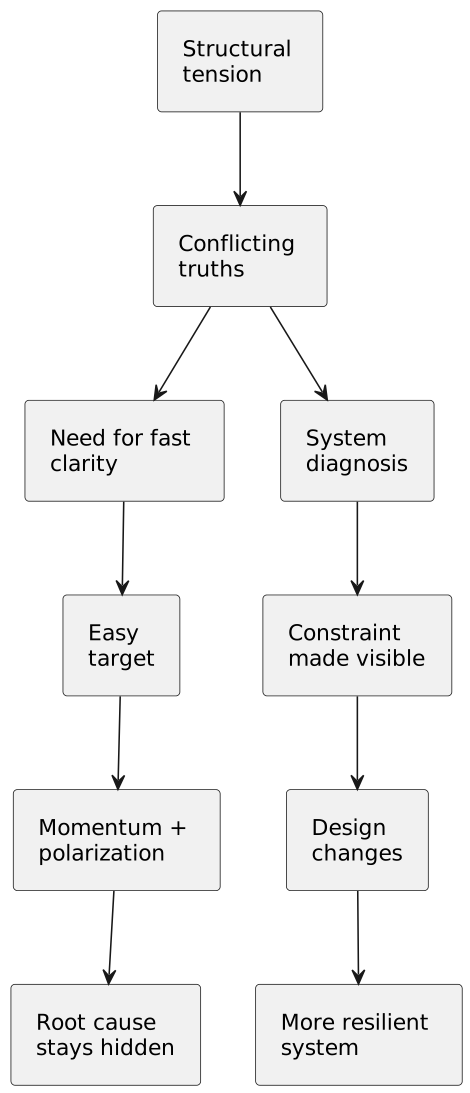
First, simplified stories are easier to share than structural explanations. “This manager is the problem” moves faster than “this organization built a role with no redundancy and no tolerance for disruption.” One creates immediate alignment. The other requires patience and discomfort.
Second, easy targets help groups regain a sense of control. Once a villain is named, everyone knows where to stand. The system does not get healthier, but the conversation gets easier to organize.
Third, leaders often mistake speed of alignment for quality of diagnosis. A room that converges quickly around a suspect can feel decisive, even when it has only moved attention away from the real constraint.
This pattern is weaker when organizations can separate conduct review from system review, and when teams still have enough slack to inspect causes before choosing sides. It gets stronger when capacity is tight, escalation pressure is high, and the room needs certainty before it has diagnosis.
How to spot target-seeking instead of diagnosis
Look for the signs in recurring debates, review forums, and operational artifacts. The question is not whether a target exists. The question is whether the target is replacing analysis.
Fast suspects. In difficult situations, the same kinds of culprits appear quickly: management, HR, engineering, product, “the business”, or one badly behaved individual. That is often a sign the group has a ready-made story before it has examined the system. A good first move is to ask what underlying tension the target is helping the room avoid.
Moral closure arrives early. The conversation reaches certainty before it reaches mechanism. People know who was wrong, but cannot explain which constraint, dependency, or design choice keeps reproducing similar episodes. Review the last three controversies and check whether the diagnosis got more precise than the judgment.
The same conflict keeps returning with new faces. Different people get blamed, but the shape of the problem stays the same. That usually means the target is replaceable because the structure is stable. Inspect where the same operational tension reappears across teams, roles, or moments.
Action focuses on correction, not redesign. The response is usually training, messaging, policy reminders, or personnel debate, while coverage gaps, overloaded handoffs, unclear ownership, or thin buffers remain unchanged. Ask which design change would make the same shortcut less likely next time.
Keep the tension visible long enough to redesign
Suggested moves: pick one to try for 1-2 weeks, then review whether the conversation became harder in the short term but more useful in the long term.
Rewrite the first question in review forums
In the next difficult case, resist the instinct to begin with “who did this?” Start with “what tension was the system unable to absorb?” This works because the first question sets the layer of diagnosis for the entire discussion. Try it in one leadership, operations, or incident review and watch whether the room surfaces constraints and trade-offs before it settles on a suspect.
Separate moral judgment from system diagnosis
When behavior is clearly unacceptable, name that directly and keep the boundary intact. Then continue the discussion on a second track: what capacity, dependency, incentive, or design weakness made this shortcut attractive in the first place? This matters because rejecting bad behavior is necessary, but it is not the same thing as understanding the system that keeps producing it.
Use one controversy as design input
Pick one recent episode that generated heat, polarization, or an obvious target, and treat it as a system case rather than a communications case. Map the workflow, the handoffs, the missing buffers, and the decision pressure around it. Start small with one case and watch whether the next similar situation produces less blame theater and more structural intervention.
The goal is not to excuse bad behavior by hiding behind complexity. It is to avoid a second mistake: using moral clarity as a substitute for systemic understanding.
Modernization maturity shows up when organizations can hold ambiguity long enough to redesign what is underneath it. Living systems do not eliminate conflict, competing truths, or uncomfortable trade-offs. They become better at not collapsing those tensions into easy targets at the first sign of pressure.
Where in your organization does structural tension still get translated into easy targets instead of better design?