
Why self-organization fails without orchestration
Self-organization only works when someone explicitly designs and maintains the purpose, boundaries, and interfaces between teams.
Autonomous teams are powerful but fragile: without clear domains, shared decision criteria, and explicit mediation rituals, self-organization turns into politics and friction. Orchestration is not command-and-control — it is the deliberate design of interfaces so autonomy produces learning instead of chaos.
Self-organization only works with orchestration
Insight: Self-organization only works with orchestration — someone must care for purpose, boundaries, and interfaces between teams.
In complex systems — from ecosystems to economies — self-organization emerges because there are clear constraints: limits, feedback loops, and simple rules that guide collective behavior. In organizations, many “teal”, agile, or squad initiatives import autonomy but forget to orchestrate these conditions. Without clarity of purpose, agreements on how to work together, and explicit mediation mechanisms, what should be adaptive quickly becomes an arena of unresolved conflict. In that vacuum, teams negotiate everything through informal power, and energy that should go into learning from change is spent defending territory.
This happens because autonomy creates interdependence pressure — and without explicit interfaces, the pressure turns into politics.
In one minute
- Autonomy without interfaces becomes negotiation-by-power and drains energy that should go into learning.
- This happens when boundaries and decision criteria stay implicit and there are no safe rituals to mediate tensions early.
- Start by making one boundary explicit and installing one recurring “tension review” ritual.
When “autonomy” becomes endless alignment
Many organizations adopt autonomy language and rituals, but keep the old ambiguity about who decides what, how trade-offs are made, and what happens when teams collide.
In that gap, teams fill in the blanks with local rules. Over time, those micro-agreements conflict, and leaders end up spending time on escalations that autonomy was supposed to prevent.
Healthy autonomy needs constraints and mediation
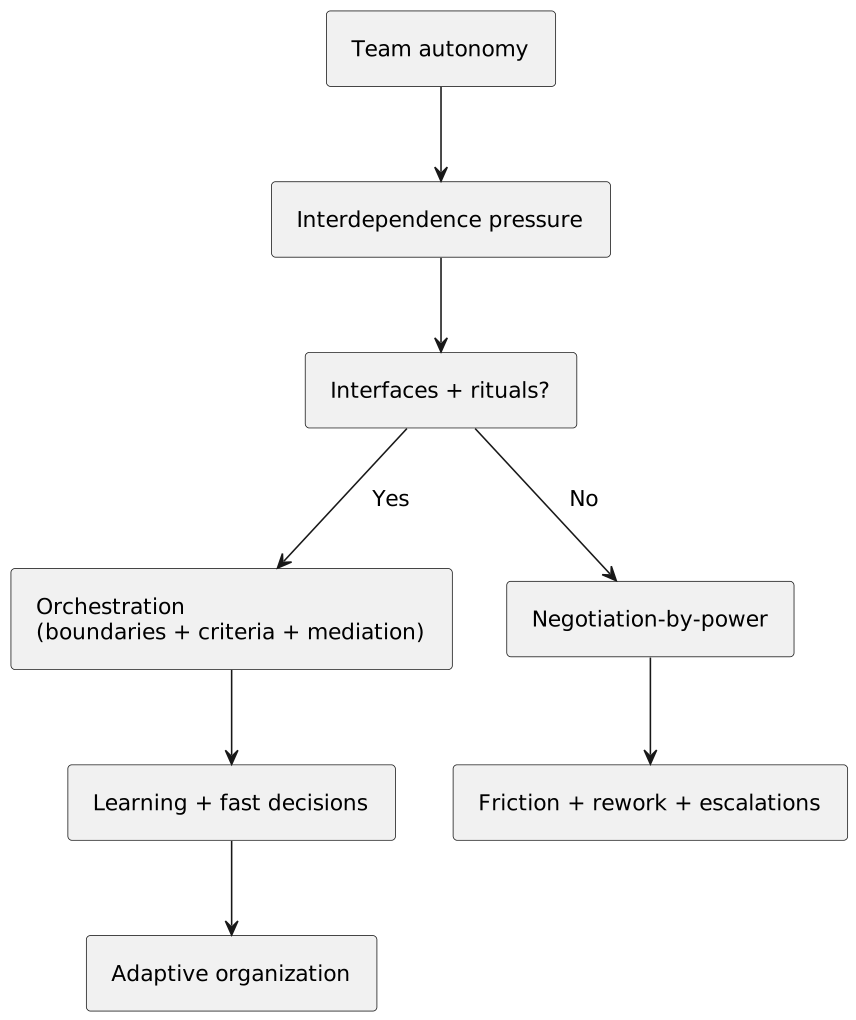
Constraints are not the enemy. Healthy systems combine local freedom with clear global guardrails.
Conflict is a signal. Interdependence creates tension. Treating conflict as “failure” prevents the organization from designing the roles and rituals needed to learn from it.
Interfaces must be explicit. Who decides what, using which criteria, and on what cadence cannot remain implicit without producing contradictory micro‑agreements.
Leadership must orchestrate. Leadership either stays in command-and-control mode or disappears, instead of acting as the orchestrator of tensions and guardian of cross-team agreements.
This pattern is lighter when teams are truly independent and decisions are reversible. It becomes essential when interdependence is high and trade-offs recur across domains with no shared mediation mechanism.
How you can spot missing orchestration
Missing orchestration shows up less as a single failure and more as background noise: alignment meetings, boundary debates, escalations that arrive late. If you want to diagnose it quickly, look at interfaces between teams, decision forums, and how conflict is handled when trade-offs are real.
Teams. Teams say “we’re autonomous” but live in constant priority disputes, rework, and endless alignment meetings. That’s local autonomy without shared decision criteria and without structured mediation between teams. A good first move is to make prioritization criteria explicit, clarify who decides in each type of tension, and design rituals that align trade‑offs across teams.
Boundaries. No one can clearly say where one team’s responsibility ends and another’s begins. Without functional boundaries, service contracts, and interface agreements, every change becomes a political negotiation. A practical way to start is to map domains, make each team’s “offers” explicit (services, expectations, limits), and document minimum entry/exit agreements between them.
Conflicts. Conflicts accumulate as side comments, hallway conversations, or late escalations to senior leadership. There are no safe, recurring spaces to deal with tensions; leadership only shows up when the crisis is already visible. One simple move is to create recurring “tension review” rituals and clear facilitation/orchestration roles focused on learning from conflict, not assigning blame.
Make boundaries and interfaces visible (then iterate)
Suggested moves — pick one to try for 1–2 weeks, then review what you learned.
Clarify the shared “why” and decision criteria
Formulate a simple, verifiable purpose that connects teams’ work to the desired outcome, and define shared prioritization criteria. This matters because purpose and criteria are the compass that keeps autonomy aligned when trade‑offs are real. Start by writing the purpose in one sentence and agreeing on 3 prioritization criteria in the next leadership forum. Watch for fewer “alignment meetings” that end with no decision.
Design explicit interfaces (domains + service agreements)
Map domains, value streams, and service agreements (what each team offers, what it expects, and which limits cannot be crossed). This matters because interfaces remove ambiguity — and ambiguity is what turns collaboration into politics. Start by picking two adjacent teams and defining one “offer” and one interface agreement in writing. Watch reduced rework and fewer escalations caused by boundary confusion.
Install mediation rituals (and redefine leadership as orchestrator)
Create recurring spaces to surface tensions, facilitate conflicts, and revise agreements as context shifts. This works because conflicts are inevitable; rituals make conflict productive instead of corrosive. Start by running a weekly “tension review” with a facilitator and a simple agenda (surface, decide, update agreements). Watch conflicts showing up early, in public, leading to concrete adjustments.
Self-organization is a powerful engine of adaptation, but it is not self‑sufficient. Without orchestration of interfaces, boundaries, and tensions, the energy of autonomy is lost in scope disputes, hidden agendas, and incoherent decisions.
If we ignore the need for orchestration, autonomy turns into “every team for itself”. Modernization then fragments into competing agendas, and the organization retreats to rigid models — reinforcing a cycle of excessive control, low adaptability, and renewed frustration.
Which boundary will you make explicit today to strengthen self-organization in your team?