About intelligent modernization
This site explores why speed without reflection creates negative legacy, and how organizations can keep learning as the world changes.
Speed has become the default. Decisions need to move faster, products need to move faster, automation needs to move faster, and organizations need to respond faster to customers, markets, regulation, and technology.
Speed is not the problem. The problem begins when an organization accelerates without enough reflection on what that acceleration leaves behind. That is how negative legacy grows: choices, processes, assumptions, data, and systems that are hard to reuse, hard to adapt, and increasingly unable to move with the world around them.
This site exists to make that pattern visible.
In one minute
- Technology can accelerate change, but it does not solve the absence of reflection.
- Negative legacy is broader than technical debt: it also lives in assumptions, workflows, decision-making, and culture.
- Intelligent modernization is about learning faster while the environment keeps changing.
What I mean by intelligent modernization
Modernization is not “new technology”. It is the capability to let an organization change without losing its direction, reliability, or identity.
That capability matters more as the environment changes faster. When customers, regulation, competition, AI, platforms, and social expectations move faster, architecture, processes, decisions, and assumptions also need to become more adaptable. When they do not, friction grows: more exceptions, more escalations, more meetings, more repair work, and less confidence in the system.
Intelligent modernization therefore does not start with the question of which technology to add. It starts with whether the organization can still observe, choose, learn, and adapt well enough.
What this site is built around
- Reflection alongside speed. Moving faster only creates value when the organization also sees what is changing, what is getting stuck, and what needs to be redesigned.
- Adaptability over novelty. New technology becomes modernization only when it makes the system easier to move with new conditions.
- Make negative legacy visible. Legacy is not only old code. It also lives in decision rules, exceptions, reports, handovers, assumptions, and habits that no longer fit.
- Keep learning close to the work. Organizations stay adaptable when signals from the work return quickly enough into choices, priorities, and design.
- Do not become technology-blind. Technology is often the strongest accelerator, but without clear intent and feedback it can also amplify old patterns.
The four lenses
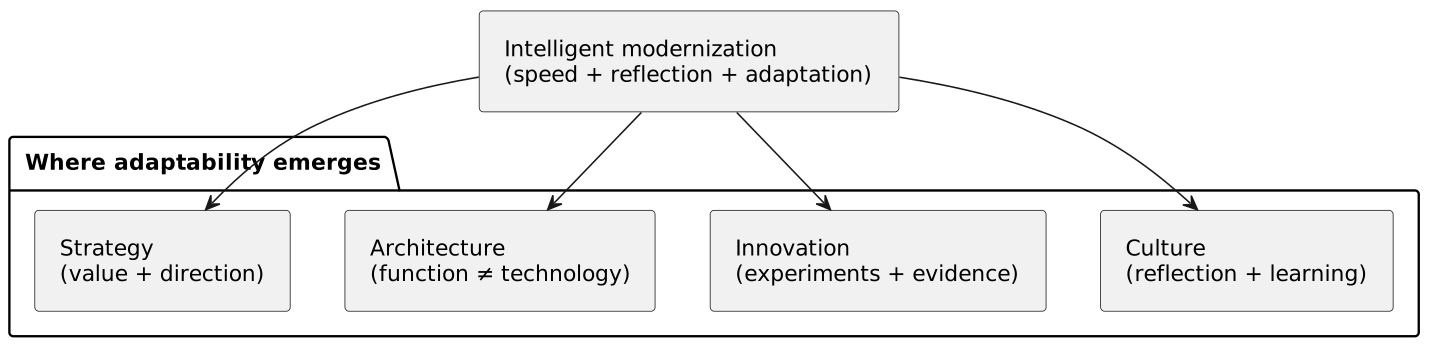
I look at intelligent modernization through four lenses. Not as separate themes, but as places where speed and reflection need to keep meeting.
Perspectives
- Intelligent Strategy — Orchestrate strategy →
- Living Architecture — Shape architecture →
- Real Innovation — Unlock innovation →
- Culture in Transformation — Cultivate a living culture →
How to use these insights
Each insight starts from a recognizable tension in real work. It then moves one layer deeper: what pattern is underneath, why does it keep returning, and what could you try differently next week?
- Insight — the thesis and the tension
- Context — where it shows up in real organizations
- Evidence — why it happens (a simple mental model)
- Signals — how to spot it in your own system
- Action — small experiments you can run next week
I do not publish opinions dressed as certainty, and I do not invent numbers to make a point sound stronger. If a claim matters, it should show up in observable signals: decisions, lead time, incidents, exceptions, handovers, meeting patterns, or recurring repair work.
Important
The point is not to argue against speed. The point is to connect speed with reflection, so change does not quietly build new rigidity.
Principles for intelligent modernization
These principles form the foundation for the articles on this site.
-
Separate function from technology. What something needs to do often changes faster than the technology it was built with. Keep function, rules, and technical execution as independent as possible. Living Architecture
-
Design for adaptation. A system that cannot move makes every change more expensive. Modernization should make reuse, adaptation, and replacement easier. Intelligent Strategy
-
Automate with intention. Automation should strengthen human judgment, not hide where nobody is thinking anymore. Make explicit what automation assumes, decides, and passes on. Real Innovation
-
Measure to learn. Metrics are not an end in themselves. They should show whether the organization is learning better, adjusting sooner, and building less negative legacy. Intelligent Strategy
-
Treat exceptions as signals. Recurring exceptions are rarely just noise. They often show where the design no longer fits reality. Living Architecture
-
Prioritize clarity over complexity. Complexity is not proof of maturity. Clear systems make better choices possible and reduce unnecessary dependency. Intelligent Strategy
-
Protect reflection as work. Reflection is not a delay beside the real work. It is how organizations prevent speed from working against itself. Culture in Transformation
The articles are freely accessible because insight only becomes valuable when it is used in real work. If a text, diagram, or idea from this site helps you in a presentation, article, internal note, or decision, keep the source visible: mention Modernizers.io and link to the original article where possible.
This site is therefore neither a plea for more technology nor a resistance to technology. It is a plea for modernization that keeps thinking while it accelerates.