When Variation Becomes Structure
Modernization scales exposure to variation, forcing leaders to decide what to eliminate, what to manage, and what to design in.
As organizations become more digital, connected, and automated, recurring exceptions stop being local annoyances. The real challenge is deciding which variation is noise, which should stay exceptional, and which has become structural enough to deserve explicit design.
Exceptions stop being exceptional faster than leaders expect
Insight: Modernization raises the cost of pretending recurring variation is still “just an exception”; once a pattern becomes frequent, meaningful, and stable, it belongs in strategy, management attention, and architecture.
It is the weekly operating review, and the same slide keeps coming back with different labels. A regional pricing case needs a manual override. A contract clause for one customer does not fit the standard path. A compliance rule for one market keeps triggering rework. A correction team is quietly fixing records after the workflow already looked “done.”
Each case looks small when viewed alone. Each seems survivable. The trouble starts when daily work shifts from running a clear operating model to interpreting, correcting, rerouting, and overriding it. Decision latency rises, automation gets brittle, reporting drifts from reality, and trust in the system starts to decay at the edges first.
That is the moment when the question changes. The issue is no longer whether the organization handles exceptions politely or heroically. The issue is whether it still understands what kind of variation it is facing.
Some of it is noise and should disappear. Some of it reflects real business difference and should stay managed without distorting the core. Some of it was once rare, but is now recurring enough that leaving it informal creates more fragility than bringing it inside the design.
This happens because modernization does not just scale process. It scales exposure to variation. More channels, more automation, more integrations, and more transactions make hidden differences visible, repeatable, and expensive to ignore.
In one minute
- Modernization does not create every exception; it makes recurring variation visible at scale.
- The real leadership task is to separate noise from meaningful difference, then decide what should be eliminated, managed, or designed into the system.
- Start with one exception queue or approval log and classify the last month of cases before you redesign anything.
The operating model changes when exception handling becomes the real work
Exceptions are easy to recognize when they are still rare. A special request, an unusual case, a manual correction, a one-off approval. In that form, they sit outside the normal flow and can be absorbed without changing much.
Many organizations stay attached to that picture long after reality has moved on. The formal process still exists on paper, but the business now runs through overrides, side procedures, spreadsheet bridges, approval rituals, and experienced people who know how to keep things moving. The system looks standardized from a distance while real work happens in the gaps.
Modernization makes that gap harder to hide. In less digitized environments, people quietly compensate for structural weakness. They interpret incomplete requests, fix data without logging it, reroute work around policy conflicts, and use judgment to preserve continuity. Once the same work becomes digital, connected, and automated, those compensations stop being invisible labor and start showing up as queue growth, repeated escalations, manual interventions, customer friction, and rule exceptions that keep coming back.
That is why transformation often feels like it is creating complexity when it is actually revealing it. This is the same placement problem described in Why stable systems need moving parts: if the design has no deliberate place for recurring variation, operations will invent one through approvals, workarounds, and side procedures.
Not all variation means the same thing
By variation, I mean the exceptions, special cases, and recurring differences in demand, context, rules, or cases that make the standard path bend. The critical mistake is treating every deviation as if it carried the same meaning. It does not.
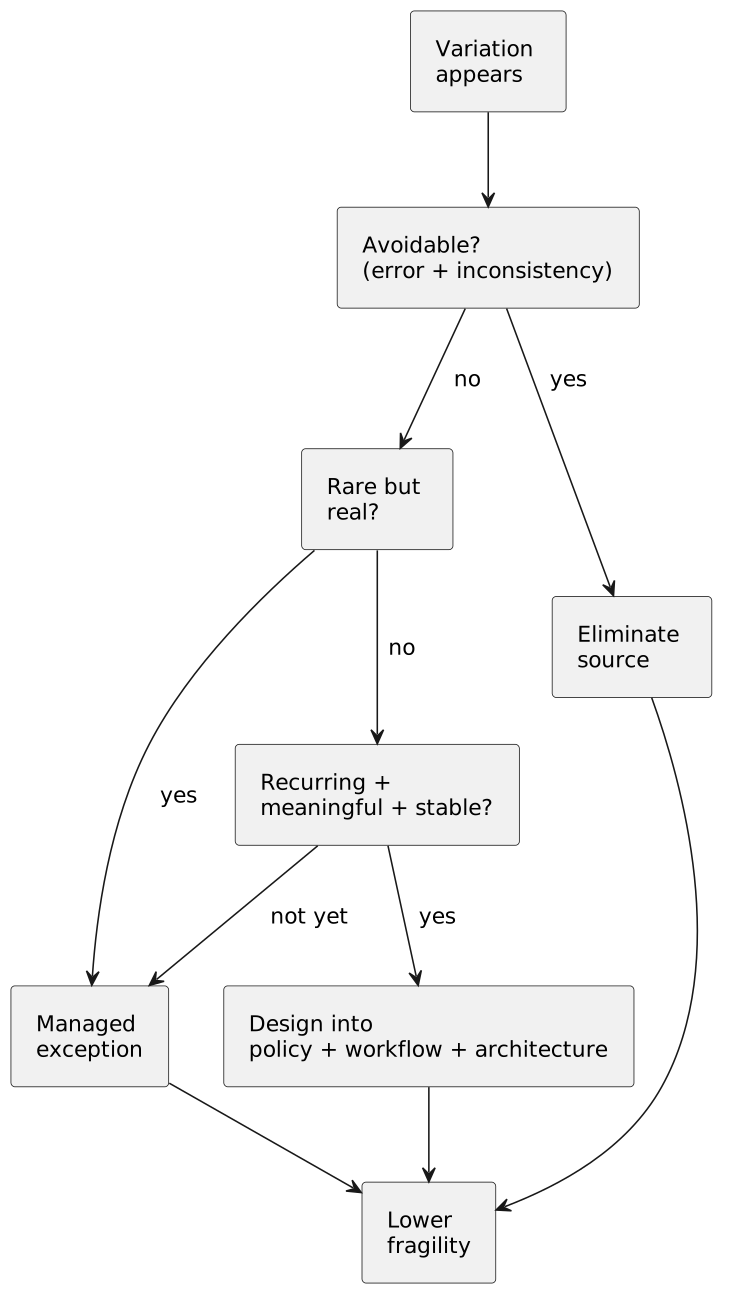
Noise should be removed. Some variation comes from inconsistency, poor data, legacy collisions, unclear rules, or preventable mistakes. It may arrive dressed as a business need, but it adds no strategic value. If the same order needs a manual correction because upstream data is incomplete, the right response is not better exception handling. It is fixing the source of the defect.
Real difference should be treated deliberately. Some variation reflects the business the organization actually chose to serve: different markets, regulatory requirements, customer tiers, service models, or risk profiles. Trying to standardize all of that away usually produces fake simplicity. The operating model becomes cleaner on paper but more distorted in practice.
Recurring patterns should move inside the design. The most dangerous category sits in the middle. A case begins as an exception, but over time becomes predictable enough that everyone knows it will return. It affects enough volume, money, risk, or customer experience that leaving it informal now creates more cost than formalizing it. That is the point where variation becomes structure.
Recurring is not enough. Structural means recurring, meaningful, and stable.
This is where the layers have to separate cleanly. Strategy decides whether a variation is desirable, tolerable, or unwanted. Management decides which signals deserve attention and which ones are just operational noise.
Architecture then decides where the pattern belongs: in the core model, in configurable policy, in workflow branching, in a review step, or in a deliberately isolated exception path. When those layers blur, every deviation starts competing for legitimacy and every local urgency feels like a special case that must win.
This logic is weaker when the pattern is temporary, such as a migration spike, a short-lived regulatory transition, or a one-time commercial concession. Not every repeated case deserves redesign. The threshold is not repetition alone. It is repetition plus meaning plus enough stability that the organization can responsibly build around it.
How to tell variation has crossed the boundary
Look in approval logs, escalation queues, incident notes, rework tickets, manual adjustment reports, and recurring leadership forums. If you want one hard number to start with, track the repeat escalation rate for one decision type or the volume of manual corrections after a workflow was marked complete. The question is not whether exceptions exist. The question is whether the same kind of difference is now shaping the system from the outside.
The same case keeps climbing the org chart. Different teams bring slightly different versions of the same request to leadership because no one owns a durable treatment. That usually means the issue is no longer local. Start by grouping the last 30 days of escalations by pattern, not by individual case.
Correction work clusters after the same step. A workflow appears complete, then manual fixes repeatedly happen in finance, operations, support, or compliance. That is a sign the formal path is too narrow for the reality it is receiving. Inspect where the “done” state still depends on backstage repair.
Debates are about legitimacy, not treatment. The room spends more time arguing whether a case is special enough to matter than deciding where it should live. That is what it looks like when the organization lacks a shared test for eliminate, manage, or design in. Review the last few disputes and see whether the disagreement was really about the case or about missing design criteria.
Exception logic leaks into many places at once. The same special handling starts appearing in scripts, training notes, spreadsheets, meeting habits, approval rules, and dashboard footnotes. That is usually a sign that the pattern has already become structure informally. A good first move is to find out how many places must now stay aligned for the workaround to keep functioning.
Classify variation before it classifies you
Suggested moves — pick one to try for 1–2 weeks, then review what changed in the queue, the conversation, and the amount of hidden repair work.
Rewrite the exception review
Take one weekly review that currently handles “special cases” and change its first question from “who can approve this?” to “what kind of variation is this?” Use three buckets only: eliminate, manage, or design in. This works because the first classification shapes every later decision. Start with the last ten cases and watch whether repeated patterns become visible before the room falls into case-by-case debate.
Define the threshold for structural variation
Choose one decision type, such as pricing overrides, contract clauses, routing exceptions, or manual data fixes, and agree in the operating review or architecture forum on the threshold that turns it into a design candidate. Frequency alone is not enough; include materiality and stability as well. Start by reviewing 30 to 60 days of cases with one business owner, one operator, and one architecture lead. Watch whether fewer issues arrive as “urgent exceptions” without any shared context.
Move one recurring pattern inside the design
Pick one variation that is clearly real, recurring, and worth preserving, then give it a proper home. That may mean a policy rule, a workflow branch, a configuration point, a reviewed override path, or a change to the data model. Keep the first move small and bounded to one slice of work. Watch manual corrections, repeat escalations, and time-to-decision for that pattern over the next two weeks.
Mature organizations do not declare war on exceptions, and they do not normalize every recurring case into the standard path. They get better at asking a harder question sooner: what kind of variation are we actually seeing here?
That question matters more during modernization because scale removes the shelter of invisibility. What used to stay local now spreads through systems, integrations, dashboards, automation, and customer experience. If the organization still has no shared logic for treating variation, digitization will not remove the problem. It will industrialize the consequences of not understanding it.
The useful next step is narrow and concrete. Pick one queue, one decision type, or one recurring override, then decide whether it should disappear, stay managed as an exception, or become part of the design.
Which recurring exception in your organization is still being managed informally even though it has already become structure?