
Real Innovation
Why modernization funding fails when it stops at go-live
Modernization funding fails when budgets pay for delivery milestones but not for the capability to keep adapting after go-live.
Projects close, tools ship, and the organization returns to the same dependency on the next funding cycle to change again. Funding design decides whether modernization becomes episodic rescue or lasting capacity.
Funding buys capability, not tools
Insight: Funding buys capability, not tools — and capabilities are what compound.
A budget gets approved for a platform, a migration, or an implementation wave. The work ships, the project closes, and the organization quietly returns to the same dependency on the next funding cycle whenever it needs to change again.
That is a funding design problem, not just a delivery problem. When money pays for tools and milestones but not for learning, operating discipline, and system health, modernization stays episodic instead of compounding.
In one minute
- If funding stops at “tool delivered”, modernization becomes a recurring rescue project.
- This happens because traditional budgets reward one-off acquisitions and milestones, not learning, flow, and ongoing system health.
- Start by reserving recurring funding for shared capabilities and tying reviews to operational outcomes, not feature lists.
Annual budgets optimize for delivery, not evolution
Traditional funding models were designed for a world of large, infrequent projects. Budgets oriented toward acquisitions reward one‑off delivery of “the tool” and discourage ongoing investment in the capabilities needed to keep systems evolving.
Once the project is “delivered”, the money moves elsewhere — even though the real work of learning and adaptation is just beginning.
What you fund is what you get
On top of this, many organizations still tie success to adoption targets and feature lists instead of flow and learning outcomes such as lead time, defects, or validated hypotheses. Contracts are fixed by scope and milestones, leaving little room for experimentation, feedback, and iterative improvement. The result is a funding logic that treats modernization as an occasional event, not as a continuous capability.
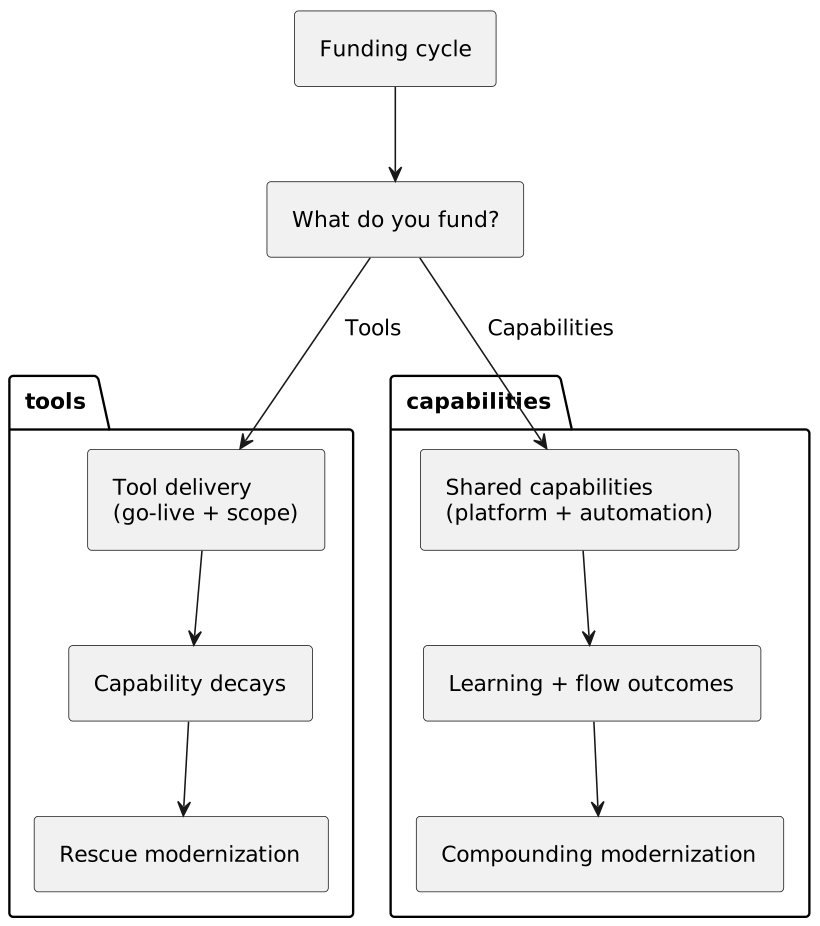
This is less relevant for one-time, tightly scoped upgrades with low uncertainty. It matters most when the work is evolutionary and learning-driven, where capability and system health determine the ROI.
Where funding is still buying tools
You can often see this funding bias in how products stall after launch and how dependent teams remain on external vendors.
Product. The project is “delivered”, but the product stands still. A tool was installed without internal capability, so evolution turns into dependence. A good first move is to fund ongoing enablement, onboarding, and product stewardship.
Autonomy. Every small change depends on a vendor, because internal platform, automation, and engineering leverage were never funded. That’s capability missing, not effort missing. A practical way to start is to allocate part of the budget to shared capabilities (platform, automation, standards).
Debt. The backlog of technical and process debt grows while investment keeps going to “new features” with no evolutionary maintenance. That’s funding signaling what counts. One simple move is to reserve recurring budget for refactoring, quality, and operational excellence.
Fund learning and system health on purpose
Suggested moves — pick one to try for 1–2 weeks, then review what you learned.
Reserve budget for shared capabilities (every cycle)
Allocate 30–40% of the budget to shared capabilities (platform, test automation, observability, security by design). This works because shared capabilities reduce dependence on rescue projects and make every product team faster and safer.
Start by identifying one capability line item you will fund recurring, not “when there’s extra”. Watch whether upgrades and improvements stop showing up as “special projects”.
Tie funding reviews to outcomes, not features
Tie reviews to outcomes (lead time, MTTR, defects, validated hypotheses) instead of feature lists and adoption targets. This matters because you get what you measure; feature funding incentivizes shipping, not learning and reliability.
Start by replacing one “feature status” slide with one “flow + learning” slide in the next steering forum. Watch whether decisions become about constraints and trade-offs instead of scope and dates.
Create a recurring evolution line (enablement + debt repayment)
Create a dedicated enablement and evolution budget (training, pairing, living documentation, and debt repayment). This works because capability decays without practice; evolution needs a protected line, not leftover time.
Start by funding one 30‑day enablement program that targets a concrete bottleneck (testing speed, deployment safety). Watch for reduced vendor dependence and a shrinking backlog of technical/process debt.
That funding logic matters because the deepest modernization debts sit beneath the visible technical debt, not just inside it.
Intelligent funding buys learning time, not just licenses and one‑off implementations. Investing in organizational intelligence is what turns the technology budget into a driver of continuous modernization.
If nothing changes, modernization will continue to consume larger budgets while delivering lower speed. Each upgrade turns into an expensive event, deepening vendor lock‑in and pulling attention away from long‑term capability building.
Where is your innovation budget still buying tools instead of capability?