
Real Innovation
When AI makes the next disruption harder to see
AI can optimize today's demand so well that the weak signals of tomorrow get filtered out before anyone learns from them.
As AI spreads through support, search, planning, and operations, organizations get faster at serving known patterns and worse at noticing emerging ones. The risk is not bad automation, but innovation narrowing into efficient repetition.
When today’s answers keep getting better
Insight: The more AI optimizes today’s patterns, the harder it becomes to notice the weak signals from which tomorrow’s disruption first emerges.
The quarterly review looks like a success. AI-assisted routing, summaries, and prioritization have improved response times, lowered handling cost, and made the operating dashboard cleaner than it has looked in months. Then someone mentions a strange cluster of customer requests that do not fit the usual categories. The room notes it, labels it isolated variance, and moves on.
Six months later, that same variance has a name. A competitor has packaged for it. Buyers now expect it. The roadmap is suddenly behind the market, not because the organization lacked data, but because it never promoted weak data into strategic attention. That is the trap. AI is exceptionally good at helping organizations process what they already understand: classify, summarize, route, rank, and respond at scale. But when leadership increasingly sees the market through systems optimized for pattern fit, reality starts arriving pre-normalized. Signals that do not yet repeat enough, or cleanly enough, get compressed into old categories before anyone decides they deserve strategic attention. That is why the danger is not bad automation. The danger is that optimization changes what the organization can still see. Real-world change happens first. Pattern recognition comes later, if it comes at all. In the gap between those two moments, disruption often looks like noise.
In one minute
- AI is powerful because it makes pattern-based action cheap enough to use almost everywhere.
- That same strength can narrow discovery, because weak signals rarely look important when they first appear.
- Start by protecting one explicit anomaly lane beside your optimized flow, then review what new categories and questions emerge from it.
This happens because systems trained to optimize known patterns tend to compress novelty into the nearest familiar category, and organizations gradually lose contact with the raw signals from which new demand first appears.
Where weak signals disappear first
Consider a software company that adds AI to customer-signal intake, account summaries, and roadmap synthesis. Known patterns improve immediately: repeated onboarding friction, familiar integration requests, standard pricing objections, common service complaints. Teams respond faster, reporting gets cleaner, and leadership feels closer to the market because more signals are being processed at lower cost. Every dashboard suggests the system is learning.
Then the world around the product starts to move, but not in one clean, visible way. One account now needs audit-ready status updates because internal controls have tightened. A second is redesigning approvals because teams no longer want people sitting inside every handoff. A third is running into awkward exceptions because partners and tools now interact with the workflow in combinations the standard path was never designed to handle. None of those changes is large enough, repeated enough, or standardized enough to look like a pattern yet.
The model does what it was designed to do: it maps each signal to the closest existing category. Some get summarized as integration friction, some as workflow requests, some as standard customer-specific variation. Because the change is still sparse and isolated, the system treats it as variation rather than evidence that reality has shifted. Sales handles one account concern, product closes one request as edge-case noise, operations patches one awkward exception. No one sees a coherent signal.
That is the dangerous interval. The real-world change happens first. Pattern recognition comes later, if it comes at all. Sometimes enough similar cases accumulate and the system catches up. Sometimes they never do, because each account experiences the shift differently and no one explicitly teaches the model what changed. By the time the need becomes obvious, someone else has already built for it.
That is how disruption usually enters an organization. It does not arrive as a clean category with a big business case attached. It arrives as scattered exceptions that do not yet deserve a stable name. AI handles the known path very well. The risk is that the better it gets at that path, the less often humans stay with the odd cases long enough to understand what is emerging.
The same pattern shows up in sales scoring, roadmap synthesis, search ranking, fraud review, and internal copilots. In that sense, this is the operational version of why Algorithms reward familiarity more than discovery: when success is defined as fast, confident treatment of what already resembles the past, the future tends to arrive looking low-confidence, messy, and easy to dismiss.
Why optimization suppresses discovery
AI lowers the cost of action, so it spreads quickly. Once a team sees that AI can classify requests, draft replies, rank leads, summarize meetings, or recommend next steps, the rational move is to apply it across more of the operating surface. Support wants lower cost to serve. Product wants faster synthesis. Sales wants better prioritization. Operations wants fewer manual touches. The more useful AI becomes, the more front doors it occupies.
That matters because most applied AI systems are not discovering truth from first principles. They are matching inputs to historical regularities, confidence distributions, and categories that worked before. That is exactly why they are so effective on known territory. It is also why they struggle with inputs that are sparse, ambiguous, or structurally different from the past. A change in customer behavior, a new rule, or a changed operating environment does not become legible to the system just because it is real. Until enough cases accumulate into a recognizable pattern, AI mostly sees scattered variation.
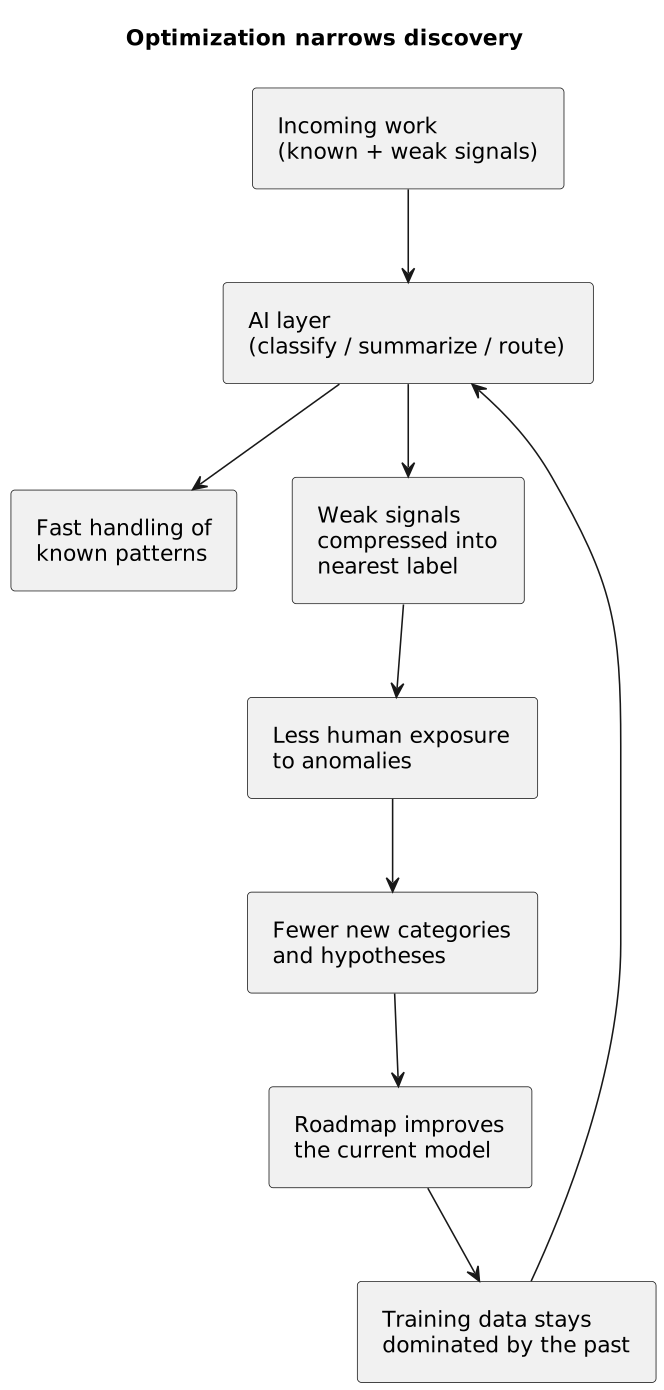
Once AI becomes the first layer of interpretation, it does not just accelerate decisions. It shapes what becomes visible enough to matter. Majority-fit cases get clean routing, crisp summaries, and high confidence. Anomalies get paraphrased, merged into existing buckets, or treated as local exceptions. The organization ends up seeing a calmer, cleaner version of reality than reality itself.
This is where several tensions become strategic at once. Pattern recognition is not the same as truth, because a plausible fit can still miss what is changing underneath. Efficiency is not the same as emergence, because emergence usually needs time with messy evidence before it becomes obvious. Outcome dominance is not the same as process understanding, because a correct-looking answer can hide the fact that no one really learned why the case did not fit, which is also how AI can raise output while weakening judgment.
New demand rarely begins as a dominant pattern. It begins as odd language, strange edge cases, small clusters, or behavior that looks uneconomic until repeated often enough to form a visible category. If those early traces are normalized on contact, innovation shifts from disruptive to incremental. The company keeps improving the current model while becoming slower to see when a different model is trying to appear.
Without a protected discovery path, the efficiency gains get reabsorbed into more throughput instead of more learning, which is the same trap behind Teams do not lack ideas; they lack slack.
This is less dangerous when the domain is stable, the work is truly repetitive, and chasing every anomaly would cost more than it teaches. It becomes strategic when new behavior first appears as low-volume exceptions, unusual wording, or customer uses the current taxonomy cannot yet describe.
How to tell innovation is narrowing
You can usually see this pattern before anyone names it. The clues appear in dashboards, review forums, account notes, search logs, policy exceptions, and roadmap debates. What matters is not whether AI is performing well. What matters is whether the organization still has a way to notice what performs badly because it is new.
Green dashboards, late surprises. Resolution rates, automation coverage, and response speed keep improving, yet the organization still feels repeatedly surprised by new customer behavior, unexpected competitor moves, or requests that “came out of nowhere.” That gap usually means you are measuring treatment of known demand, not sensitivity to emerging demand. Start by tracing the last few strategic surprises back to where the first faint signal appeared and whether the AI layer had already touched it.
Customer language gets normalized too early. Generated summaries rewrite unusual requests into standard labels, which makes reporting cleaner and discovery worse. Preserve raw verbatim input for low-confidence, cross-category, or repeatedly resurfacing signals, then inspect whether the original wording suggests a new job to be done.
Exceptions are treated as residue. Teams talk about odd cases as operational waste to be cleared, not strategic material to be examined. When the same “one-offs” keep reappearing with slight variations, the organization may be watching a new category form without realizing it. Review recurring exceptions before you optimize them away.
Roadmaps keep improving the current model. Prioritization becomes sharper, but most bets remain extensions of the existing offer: better routing, faster handling, more personalization inside the same commercial logic. Ask in roadmap reviews how many recent opportunities came from anomalies rather than from better serving the dominant segment.
Human reviewers see aggregates, not edge cases. Leaders get dashboards and summaries, while the messy inputs disappear one layer below. Put a small sample of raw off-pattern cases into the same review forum that celebrates efficiency gains and see whether the conversation becomes more diagnostic and less certain.
Protect discovery while scaling AI
Suggested moves, not mandates. Pick one to try for 1–2 weeks, then review what you learned. The goal is not to slow optimization down. It is to keep a second lane open for emergence.
Create an anomaly lane beside the optimized flow
Keep AI on the majority path, but route low-confidence, cross-category, or repeatedly resurfacing signals into a named weekly review with product, operations, and technology in the room. This works because disruption usually starts below the threshold that standard reporting treats as important. Start with one workflow and a small cap of raw signals so the review stays real. Watch whether new categories, rule changes, or opportunity hypotheses begin to emerge from material that previously looked like noise.
Govern AI with discovery metrics, not only efficiency metrics
If the dashboard only tracks speed, cost, automation rate, and precision on known labels, the system will keep getting better at the present and worse at sensing the future. Add two or three discovery measures to the same governance forum: share of raw anomalies reviewed, time from anomaly cluster to decision, and count of new categories or rule changes created from reviewed cases. Start with one existing dashboard instead of a new reporting ritual. Watch whether anomaly work survives when efficiency numbers are already strong.
Turn recurring weak signals into cheap experiments
When a strange cluster appears, do not wait for full certainty or a mature business case before acting. Fund a small experiment: a prototype, a new rule, exploratory interviews, or a limited workflow pilot. This works because weak signals only become visible categories after someone holds them long enough to test what they might mean. Start with one unusual cluster from the last month and assign a two-week learning goal. Watch whether the experiment changes your taxonomy, your roadmap, or at least the questions leadership starts asking.
AI will keep getting better at compressing the present into fast decisions. Organizations that benefit most will not reject that power. They will refuse to confuse optimization with perception.
The next disruption rarely arrives as a well-labeled opportunity. It starts as a few strange requests, an exception pattern, or customer language that does not fit the current map. If your systems optimize those signals away, you become efficient at yesterday precisely when tomorrow begins.
The strategic design challenge is dual: let AI dominate the known path, but protect a discovery path where ambiguity, anomaly, and low-confidence inputs are still allowed to teach you something.
Where is AI making your current model more efficient while hiding the weak signals that should challenge it?