
Intelligent Strategy
Success does not scale by itself
Success lowers scrutiny exactly when scrutiny matters most: before a result becomes a model to copy.
A local win is not proof of scalability. It may depend on hidden orchestration, pressure absorbed by one person, or exceptions that break when more teams, volume, and variation arrive.
Success does not scale by itself
Insight: A successful result is not repeatable unless the behaviors, processes, interfaces, and decisions that carried it can repeat too.
In the operating review, the autonomous team looks healthy. Delivery is moving, escalations are low, and nobody is asking for more control. Then the request arrives: turn this success into a model for other teams, regions, or portfolios. The weak signal is quieter than failure. One high performer may be preserving decision quality, accountability, and coordinated execution by absorbing pressure between teams.
Failure is forced to explain itself because it interrupts the system. Success often escapes that pressure because it creates relief, legitimacy, and the desire to copy. That is exactly why success deserves scrutiny before replication. This is not treating success as failure; it is refusing to replicate success blindly. Complex organizations rarely repeat context by default. To challenge success is to test whether the behaviors, processes, interfaces, and decisions that carried the result can survive more volume, more teams, and more variation. The strategic question is not only “what worked?” It is “which enablers must travel if this result is expected to repeat?” This happens because success changes the burden of proof: once something looks legitimate, the organization protects it, expands it, and stops asking whether the system can actually carry it.
In one minute
- Success lowers scrutiny exactly when scrutiny matters most: before a result becomes a model to copy.
- A successful result is not repeatable by itself; the behaviors, processes, interfaces, and decisions that carried it have to be repeatable.
- Before replication, challenge what must travel: decision clarity, interface quality, pressure absorption, and system effect.
Where good results hide fragile enablers
The pattern often starts with a small, legitimate win. A team reduces cycle time, a regional unit improves customer response, a product group handles a difficult launch, or a transformation cell shows progress faster than the rest of the organization. The result is visible, and the story is attractive: this is what good looks like.
But the operating reality may be less transferable. The win may have worked because a senior sponsor removed blockers every morning. It may have depended on a high performer who knew who to call, which rule could bend, which system could not be trusted, and which stakeholder needed to hear the message first. Under pressure, that person preserved quality, accountability, and coordination, but the system did not learn how to do it. The success may also have used manual work, temporary priority, informal architecture, or exception logic that was acceptable in one context but dangerous at scale.
That is why small successes still deserve challenge. Not suspicion, not cynicism, and not bureaucratic drag. A small success can be legitimate without being scalable. Challenge means testing whether the win strengthened the system or only worked locally, and whether the behaviors and processes behind it can survive a broader landscape of customers, teams, constraints, and exceptions. A team can be excellent and still reveal missing orchestration around boundaries, decision rights, interfaces, and shared intent.
This is the same structural concern behind autonomy without orchestration: local freedom only scales when the organization knows which boundaries are stable, which interfaces must be explicit, and which tensions need mediation. Success without that clarity becomes a nicer-looking version of the same fragmentation.
Scalable success is an enabler test
By scalable success, I mean a success whose supporting behaviors, processes, interfaces, and decision rules can be repeated under normal operating conditions, including broader and more varied operating contexts, without relying on hidden hero behavior, private context, temporary exceptions, or coordination that only the original team can perform. Some wins are not scalable yet, and that does not make them false. It means they are useful and worth learning from, but they should not be copied unchallenged; the challenge determines whether they can repeat as-is, need redesigned enablers, or should stay local.
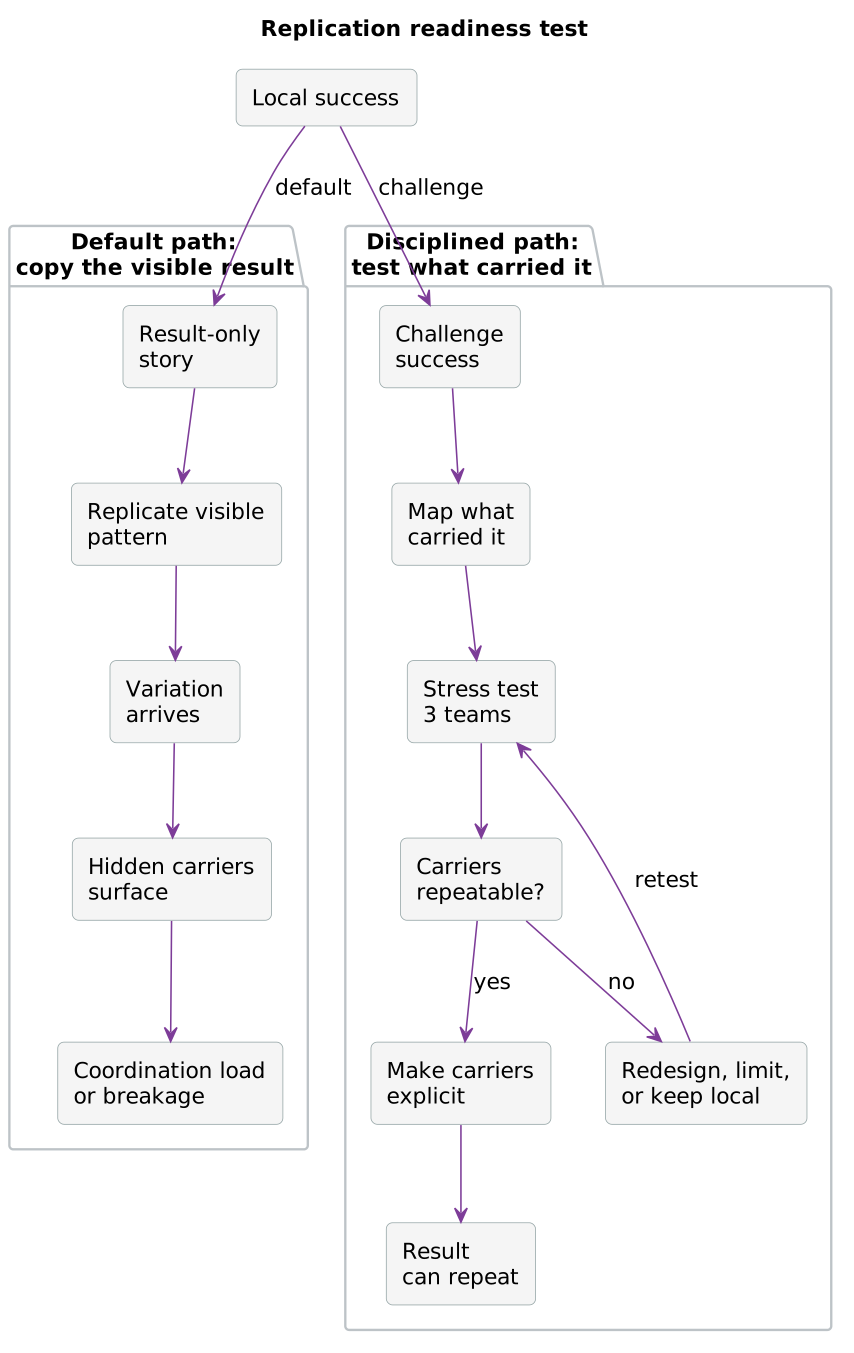
The mental model is simple: a result is not the same thing as a capability. A result says something happened. A capability says the organization can make it happen again because the enablers are known, owned, transferable, and affordable to operate.
The model has two paths. If success stays a result-only story, the organization copies the visible pattern and variation exposes the hidden carriers: the behavior, judgment, workarounds, or interfaces that were making the result possible. If the organization challenges success, it maps what carried the win and stress-tests those carriers in less favorable conditions, such as three teams that were not hand-picked for the pilot.
Understanding the enablers is not a green light by itself. It creates the next test: can those enablers work when the context becomes less friendly, such as a different team, a different region, a different customer mix, or a different exception pattern? If the enablers can travel, scale them and the result has a chance to repeat under new conditions. If they cannot, redesign the enablers, constrain the rollout, or keep the success local instead of turning it into a fragile expansion.
Three forces turn unchallenged success into complexity.
Legitimacy lowers scrutiny. Failure has to explain itself. Success often does not. Once a result is accepted as “good”, people become less willing to inspect the messy conditions behind it. The story becomes cleaner than the operating model.
Local optimization hides system cost. A team can improve its own metric by adding work to another team, increasing exception handling, tightening an interface informally, or depending on a person who absorbs ambiguity. Locally, the dashboard improves. Systemically, the organization has created a coordination debt.
Replication multiplies assumptions. When a successful pattern is copied without the enablers that made it viable, each new context improvises its own version. The organization gets more variants, more meetings, more interpretation, and more escalation while believing it is scaling a proven model.
The more varied the operating landscape becomes, the less credible it is to assume success will replicate by default. Different teams, customers, regions, constraints, and exception patterns are not noise around the model; they are part of the requirement. Every success headed for replication deserves challenge, but the depth depends on size, risk, reversibility, and intended reach. A small local win may need a short enabler review; a cross-regional rollout or strategic operating-model change needs a deeper test.
Signals that replication is carrying hidden complexity
Look for the pattern in operating reviews, rollout plans, decision records, escalation logs, dependency maps, and the informal work people do around the official process. The question is not whether the success was real. The question is whether the organization understands what it is about to replicate.
Celebration outruns explanation. The result is praised, but no one can clearly name the enablers that made it possible. If the success story contains only outputs and no operating assumptions, add a short enabler review before approving replication.
One person is the pressure valve. A high performer keeps the work coherent by translating priorities, resolving conflicts, remembering exceptions, and connecting teams that do not have clear agreements. That person may be excellent, but excellence is masking a missing interface. Start by mapping the decisions and handoffs they quietly mediate.
The rollout needs more coordination than the pilot. Every new team requires extra alignment meetings, side conversations, exception approvals, and leadership attention. That usually means the pattern was replicated faster than its enablers. Track dependency count, decision latency, and repeat escalations as the pattern expands.
Local metrics improve while adjacent work gets heavier. One unit shows progress, but downstream teams see more rework, manual correction, or unclear requests. That is successful local optimization creating systemic complexity. Review upstream and downstream signals before declaring the model scalable.
The exception becomes part of the recipe. The original success depended on urgency, temporary priority, manual intervention, or a rule being bent, and the replicated version quietly assumes the same treatment. This is where recurring exceptions stop being exceptions: what started as special handling becomes operating structure without being designed as one.
Challenge the enablers before replication
Start with one success the organization already wants to replicate. Challenge the enablers for one to two weeks, then review what becomes visible.
Review the enablers behind success
Before turning a win into a model, ask the leadership or operating review to document and challenge the enablers that made it work: people, decision rights, data quality, interfaces, urgency, sponsorship, manual work, exceptions, and constraints. This works because success becomes safer to replicate when the organization can separate transferable enablers from local circumstances. Start with the next win already moving toward rollout, and watch how many hidden dependencies appear before expansion begins.
Run the three-team replication test
Before approving replication, ask a blunt question in the portfolio or operating forum: if three teams we did not hand-pick copied this next month, what would break first? Use the answer to name the missing decisions, interfaces, support routines, and exception rules before the rollout begins. This works because chosen pilot teams are often unrepresentative; the replication test exposes whether the success depends on favorable local conditions. Watch for fewer rollouts that need extra meetings, hidden translators, or emergency exceptions after expansion starts.
Turn hero behavior into explicit interfaces
When one high performer is holding a success together, do not punish the person by calling it a risk and moving on. Use their work as evidence. Identify which decisions they clarify, which conflicts they absorb, which exceptions they recognize, and which handoffs they repair. Then convert one recurring pattern into an interface agreement, decision rule, or escalation trigger owned by the relevant forum. Watch whether the work still flows when that person is not in the room.
Success should create confidence, but confidence should not end the inquiry. The best wins are not the ones protected from challenge; they are the ones that survive enough challenge to become real capability.
Modern organizations cannot remove complexity. They can decide whether complexity is visible, governed, and aligned, or whether it spreads through hidden dependencies and local exceptions. That decision often starts earlier than leaders expect, not when failure appears, but when success begins to look obvious.
The next step is narrow: take one recent win and ask which enablers made it possible, which of those enablers can travel, and which ones must be redesigned before replication.
When was the last time your organization challenged a success before replicating it?